---
title: Predictive Alerts Cut Supplier Delays 40%
description: AI-driven alerts analyze ERP, IoT and external data to flag risks 24–48 hours early, cutting supplier delays by ~40% and lowering costs.
image: https://assets.seobotai.com/cdn-cgi/image/quality=75,w=1536,h=1024/tryleverage.ai/69f7aed874a8318574a4ce79-1777841794868.jpg
---
[Skip to main content](https://tryleverage.ai/blog/predictive-alerts-reduce-supplier-delays-40-percent#main-content)
[   ](https://tryleverage.ai)
- Show submenu for Platform Platform
- [CONNECT: Integrations](https://tryleverage.ai/integrations)
- [PARSE: Document Parsing](https://tryleverage.ai/document-parsing)
- [MEASURE: Supplier Performance](https://tryleverage.ai/supplier-performance)
- [PAY: Trade Finance](https://tryleverage.ai/payments)
- [ENGAGE: PO Automation](https://tryleverage.ai/purchase-order-automation)
- [TRACK: Shipments](https://tryleverage.ai/shipment-tracking)
- [COPILOT: AI Agents](https://tryleverage.ai/artificial-intelligence)
- Show submenu for Case Studies Case Studies
- [Manufacturing](https://tryleverage.ai/case-study-manufacturing)
- [Distribution](https://tryleverage.ai/case-study-distribution)
- [Pharma & Biotechnology](https://tryleverage.ai/case-study-pharma-biotechnology)
- [Food Production](https://tryleverage.ai/case-study-food-production)
- [Furniture](https://tryleverage.ai/case-study-furniture)
- [Supplements](https://tryleverage.ai/case-study-supplements-manufacturing)
- [Packaging](https://tryleverage.ai/case-study-packaging-manufacturing)
- [Automotive Parts Distributor](https://tryleverage.ai/case-study-auto-parts-distributor)
- [Commercial Equipment](https://tryleverage.ai/case-study-commercial-equipment)
- [Wood Processing Equipment](https://tryleverage.ai/case-study-wood-processing-equipment)
- Show submenu for Company Company
- [Our Story](https://tryleverage.ai/our-story)
- [Podcast](https://tryleverage.ai/podcast)
- [Blog](https://tryleverage.ai/blog)
- [Careers](https://tryleverage.ai/careers)
- [Partners](https://tryleverage.ai/partners)
- [Contact Us](https://tryleverage.ai/contact)
Open main navigation
Close main navigation
- Show submenu for Platform Platform
- Platform
- [CONNECT: Integrations](https://tryleverage.ai/integrations)
- [PARSE: Document Parsing](https://tryleverage.ai/document-parsing)
- [MEASURE: Supplier Performance](https://tryleverage.ai/supplier-performance)
- [PAY: Trade Finance](https://tryleverage.ai/payments)
- [ENGAGE: PO Automation](https://tryleverage.ai/purchase-order-automation)
- [TRACK: Shipments](https://tryleverage.ai/shipment-tracking)
- [COPILOT: AI Agents](https://tryleverage.ai/artificial-intelligence)
- Show submenu for Case Studies Case Studies
- Case Studies
- [Manufacturing](https://tryleverage.ai/case-study-manufacturing)
- [Distribution](https://tryleverage.ai/case-study-distribution)
- [Pharma & Biotechnology](https://tryleverage.ai/case-study-pharma-biotechnology)
- [Food Production](https://tryleverage.ai/case-study-food-production)
- [Furniture](https://tryleverage.ai/case-study-furniture)
- [Supplements](https://tryleverage.ai/case-study-supplements-manufacturing)
- [Packaging](https://tryleverage.ai/case-study-packaging-manufacturing)
- [Automotive Parts Distributor](https://tryleverage.ai/case-study-auto-parts-distributor)
- [Commercial Equipment](https://tryleverage.ai/case-study-commercial-equipment)
- [Wood Processing Equipment](https://tryleverage.ai/case-study-wood-processing-equipment)
- Show submenu for Company Company
- Company
- [Our Story](https://tryleverage.ai/our-story)
- [Podcast](https://tryleverage.ai/podcast)
- [Blog](https://tryleverage.ai/blog)
- [Careers](https://tryleverage.ai/careers)
- [Partners](https://tryleverage.ai/partners)
- [Contact Us](https://tryleverage.ai/contact)
- [Login](https://app.lvrg.ai/signin)
[See Demo](https://tryleverage.ai/request-a-demo)
[Login](https://app.lvrg.ai/signin)
[See Demo](https://tryleverage.ai/request-a-demo)
# How Predictive Alerts Reduce Supplier Delays by 40%
.png?width=40&height=40&name=elizabeth-anderson-square%20(1).png)
By [Elizabeth Anderson](https://tryleverage.ai/blog/author/elizabeth-anderson) · May 14, 2026, 7:39:52 AM
**TL;DR:** Predictive alerts, powered by AI, help businesses reduce supplier delays by 40% through early risk identification and proactive measures. By analyzing real-time data from supply chains, these systems flag potential disruptions like late shipments or quality issues before they escalate, enabling faster responses and cost savings.
Supplier delays can halt production, increase costs, and damage customer trust. Predictive alerts solve this by using AI to analyze data from ERP systems, IoT sensors, and external factors like weather or traffic. These alerts provide early warnings - 24 to 48 hours in advance - allowing teams to act quickly, reroute shipments, or adjust schedules. Companies using predictive alerts have cut delays by 30–40%, reduced logistics costs by 20%, and saved thousands annually. With easy ERP integration, these tools are transforming supply chain management.
Key Benefits of Predictive Alerts for Manufacturers
- **40% fewer supplier delays** — early warnings 24–48 hours before disruptions reach production
- **20% lower logistics costs** — eliminate emergency air freight and last-minute broker fees
- **50% faster supplier response** — automated follow-up and escalation keeps vendors accountable
- **15–25% reduction in inventory carrying costs** — right-sized stock based on real delivery data
- **Focus only on the 10–15% of POs that need attention** — exception-based alerting, not inbox overload
- **Setup in under 90 minutes** — ERP-agnostic, no custom development or IT queue time required
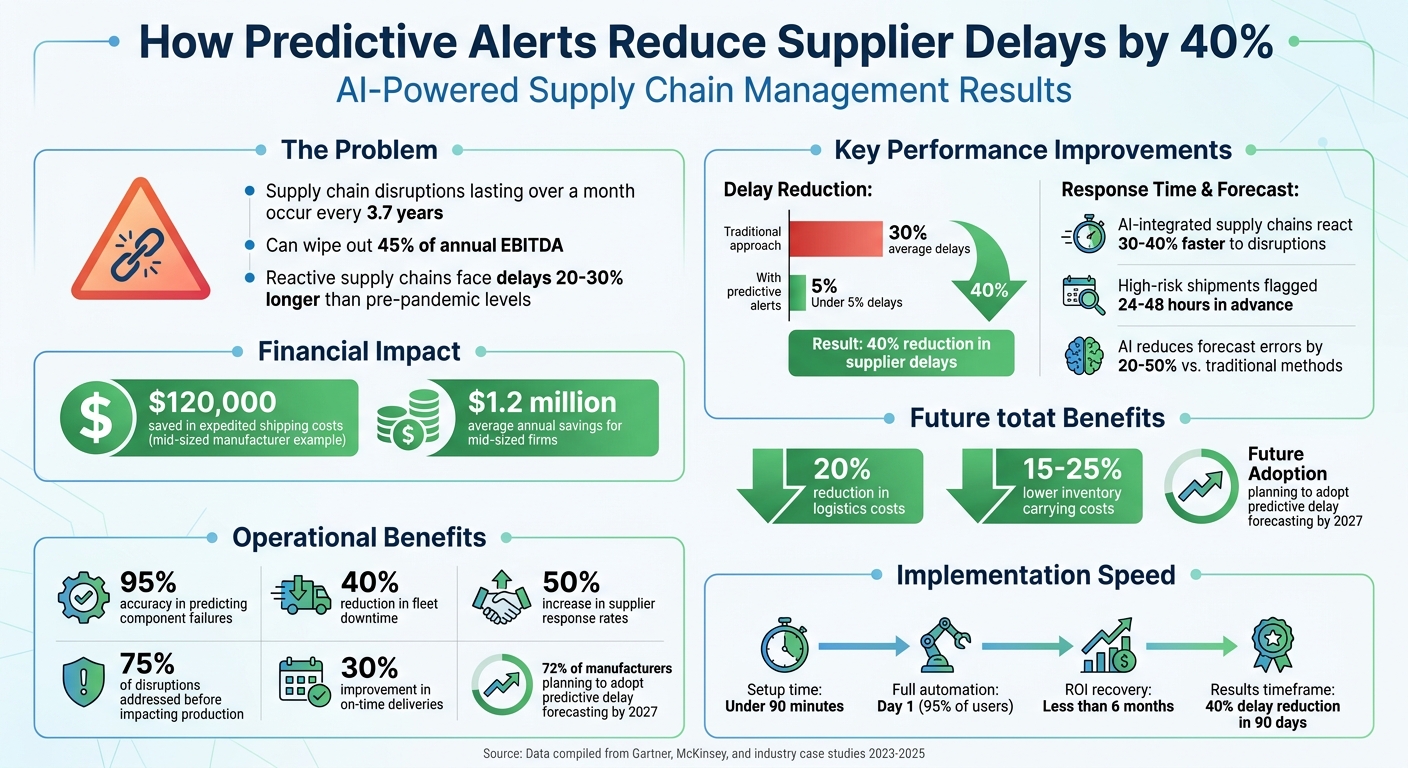
How Predictive Alerts Reduce Supplier Delays: Key Statistics and Benefits
## AI-Powered Custom Alerts in Supply Chain | Proactive Risk Management with [SAP](https://www.sap.com/index.html)
###### sbb-itb-b077dd9
## How Predictive Alerts Use AI to Forecast Delays
Predictive alerts powered by AI pull together data from a variety of sources, analyze patterns, and flag potential risks before delays even happen. Unlike older forecasting methods that rely heavily on past sales data and basic linear models, AI systems process *real-time* information, adapting quickly to changing conditions. The results? Machine learning algorithms can **cut forecast errors by 20% to 50%** compared to traditional methods, and AI-integrated supply chains react to disruptions **30% to 40% faster** than older systems. This adaptability hinges on using a wide range of real-time data inputs.
### Where Predictive Alerts Get Their Data
AI-driven predictive alerts gather information from a mix of sources, including ERP platforms, Warehouse Management Systems (WMS), and Transportation Management Systems (TMS). They also tap into IoT sensors that track GPS, temperature, and vehicle usage. Beyond internal systems, these alerts incorporate external factors like weather conditions, traffic patterns, port congestion, geopolitical disruptions, and even the financial health of suppliers. By combining these inputs, AI creates a detailed, up-to-the-minute view of the entire supply chain.
### How AI Predicts Delays Before They Happen
With this wealth of data, AI identifies patterns that traditional methods often miss. Machine learning models, such as Recurrent Neural Networks (RNNs) and Long Short-Term Memory (LSTM) networks, excel at uncovering these hidden trends. For example, AI systems monitor real-time shipment data and compare it against expected delivery timelines to detect early signs of delays.
A 2025 Proof of Concept on a maritime route from Al Jubail to Valencia illustrates this capability. The AI system accurately flagged several delay factors, including military activity (+3 days), labor strikes (+2 days), GPS jamming (+0.5 days), and vessel congestion (+1 day). These models continuously refine their predictions, learning from new data to become even more precise over time.
### Making Decisions with Real-Time Information
AI systems don’t just predict delays - they empower teams to act on them. High-risk shipments can be flagged **24 to 48 hours in advance**, giving managers crucial time to respond. Instead of reacting after a delay occurs, teams receive alerts directly through tools like ERP systems or [Slack](https://slack.com/). This real-time visibility brings together data on supplier production, in-transit shipments, and inventory levels, making it easier to make informed decisions.
Raj Jaasthi, Principal at Ernst & Young LLP, underscores the importance of solid data management in enabling these systems:
> "A unified data model is the bedrock for future AI programs. Without trusted, integrated data, AI initiatives falter."
## Proven Results: 40% Fewer Supplier Delays
Switching from reactive to [proactive supply chain management](https://blog.tryleverage.ai/blog/250424-no-surprises-resilient-predictable-supply-chain-ai) delivers clear, measurable improvements. According to [Gartner](https://www.gartner.com/en) and [McKinsey](https://www.mckinsey.com/), organizations that integrate advanced AI tools can expect a 30–40% reduction in delivery delays by 2026, thanks to predictive rerouting and better demand alignment. In contrast, supply chains that rely on reactive strategies continue to face delays that are 20–30% longer than pre-pandemic levels. Companies using predictive analytics have already managed to cut average supply delays from 30% to under 5%. Sarah Whitman from [Debales AI](https://debales.ai/) highlights the impact:
> "By leveraging Predictive Maintenance at Scale... leading logistics firms are now reducing fleet downtime by 40%".
These results showcase the transformative power of predictive systems, with practical examples to back up the numbers.
### Case Study: Cutting Delays by 40%
Manufacturers adopting machine learning–driven predictive analytics have significantly boosted supply chain reliability. In one case, a company reduced average delays from 30% to under 5% while also cutting logistics costs by 20%. This was achieved by eliminating the need for expensive air freight and last-minute brokerage fees. Early warning systems played a key role, enabling planners to address 75% of potential disruptions before they could ripple through production schedules.
The financial stakes are high. On average, supply chain disruptions lasting over a month occur every 3.7 years and can wipe out 45% of a company’s annual EBITDA. Predictive systems help mitigate these risks by moving away from reactive "break-fix" cycles to autonomous orchestration. AI-powered tools monitor vehicle health and predict component failures with over 95% accuracy. These advancements underline how predictive alerts are reshaping supply chain performance.
### What Manufacturers and Distributors Gain
Beyond reducing delays, predictive systems offer manufacturers and distributors major operational advantages. For example, predictive alerts can lower inventory carrying costs by 15–25% while improving service levels. Exception-based alerting allows procurement teams to focus on the 10–15% of purchase orders flagged for risks or changes, reducing the need for manual oversight of every open order.
McKinsey & Company describes this shift:
> "The organizations winning in today's volatile supply chain environment don't just forecast demand more accurately. They've fundamentally transformed decision-making from reactive firefighting to proactive optimization".
Predictive maintenance reduces unexpected fleet and equipment downtime by 40%, while AI-driven forecasting lowers errors by 20–50% compared to traditional spreadsheet-based methods. These improvements highlight the value of proactive, data-driven decision-making made possible by predictive alerts.
## Setting Up Predictive Alerts with [Leverage AI](https://tryleverage.ai/)
You can get started with Leverage AI in under 90 minutes, and 95% of users report achieving full automation on the first day. This quick setup lets you immediately implement proactive risk management strategies. Once connected to your ERP system, the platform begins identifying potential delays right away.
Implementation Roadmap: 0 to Live in 90 Days
Day 1
**Connect ERP**
API integration, field mapping, webhook config. Most ERPs go live same day.
Week 1
**Configure Alerts**
Set thresholds, supplier tiers, escalation rules. First automated follow-ups send.
Day 30
**First Scorecard**
Supplier scorecards populated. Baseline delay rate established. Review top 10 risk suppliers.
Day 90
**Measure ROI**
40% delay reduction typical. Export report, calculate expediting cost savings, present to leadership.
### Connecting to Your ERP System
The first step is linking Leverage AI to your ERP system. The platform supports major ERP providers like SAP, [Oracle NetSuite](https://www.netsuite.com/portal/home.shtml), [Microsoft Dynamics 365](https://www.microsoft.com/en-us/dynamics-365), and [Epicor](https://www.epicor.com/en-us/) through API connections. From the dashboard's ERP Setup section, you’ll need to enter your SAP tenant URL, client ID, and secret key. These details allow the system to access purchase order and supplier data. Once authorized, Leverage AI automatically configures webhooks to send follow-up emails if suppliers take over 24 hours to respond.
Field mapping happens automatically, enabling instant alerts for issues like delayed ETAs. For example, a mid-sized U.S. manufacturer using Oracle ERP saw their delay rate drop from 18% to 10.8% in just 90 days - a **40% improvement**. Supplier response times also decreased from 72 to 40 hours. The financial impact? They saved **$120,000** in expedited shipping costs, all tracked through Leverage AI’s dashboard.
### Improving Supplier Communication and Tracking
After connecting your ERP system, Leverage AI processes live data streams and uses AI to send personalized, proactive communications. For late shipments, the system sends a reminder on the first day and escalates on the second. This method has been shown to boost supplier response rates by **50% on average**.
Leverage AI also builds [supplier scorecards using historical data](https://tryleverage.ai/supplier-performance) on delivery times, response speeds, and quality metrics. These AI-driven scorecards help identify underperforming suppliers through automated "health checks." By addressing these issues, users have reported a **30% improvement in on-time deliveries**. With these tools in place, you can track and measure the platform’s impact on your operations.
### Tracking Results After Implementation
The Analytics dashboard offers real-time tracking of supplier delays, response times, and delivery performance. You can set custom benchmarks - like reducing delays to under 10% or cutting response times to under 24 hours - and export reports in CSV or PDF formats. Use A/B testing over 30-90 day periods to measure ROI. Common results include a **40% drop in supplier delays**, **25% faster response times**, and annual savings of **$50,000**. Most users recover their investment in less than six months.
## Best Practices for Using Predictive Alerts
Predictive alerts have been shown to significantly reduce supplier delays, but their true value lies in how they are used. By targeting the areas with the most impact, you can turn these alerts into real-time operational gains, improving supply chain performance and reducing costly disruptions.
### Focus on High-Risk Situations
Not every alert demands equal attention, so it's essential to prioritize those with the highest potential impact. Start by ranking alerts that combine factors like order value and delay probability. For example, focus on suppliers with reliability rates below 80%, delays exceeding 15%, or orders valued at over $50,000. According to the 2023 Gartner Supply Chain Report, companies that concentrated on high-risk alerts saw a 28% reduction in delays within six months.
Pay special attention to sole-source suppliers - those without backup options pose the greatest risks. By addressing these critical alerts first, you can allocate resources more effectively and tackle the most pressing threats before they disrupt production. This strategy also lays the groundwork for using supplier data to identify and address vulnerabilities.
### Use Supplier Data to Spot Problems Early
Supplier data can be a goldmine for identifying potential disruptions before they escalate. Tools like digital scorecards that monitor metrics such as on-time delivery (above 95%), quality defect rates (below 2%), and response times (less than 24 hours) can integrate seamlessly with predictive systems. For example, setting thresholds in your ERP system - like generating alerts when OTIF (on-time, in-full) rates drop below 85% - enables early detection of issues.
One Midwest manufacturer discovered a vendor's defect rate spiked from 1.5% to 4.2%, triggering an alert. This early warning allowed them to qualify backup suppliers and avoid a two-week production delay. According to the 2024 [Deloitte](https://www.deloitte.com/global/en.html) Global Supply Chain Survey, 62% of leaders using supplier data analytics to predict disruptions managed to respond 25% faster. Once anomalies are flagged, quick action becomes critical.
### Take Action to Prevent Delays
The key to making predictive alerts effective is acting on them immediately. Contact the supplier within four hours of receiving an alert and evaluate alternatives. While expedited air freight can cost 2–3 times more than ocean shipping, it can reduce delays from 40 days to just five. For instance, one distributor rerouted a delayed component via expedited trucking, incurring an additional $5,000 in costs but avoiding a $75,000 production halt. They also shifted 20% of their volume to a backup supplier, cutting delays by 35% and boosting on-time delivery rates from 82% to 96%.
Preventative actions might include expediting shipments, reallocating orders to backup suppliers, or adjusting production schedules to maintain workflow continuity. McKinsey & Company reports that proactive responses to predictive alerts can lower inventory holding costs by 15–20%. The faster you act, the more effectively you can mitigate disruptions and optimize supply chain performance.
## Conclusion
Supplier delays can wreak havoc on production schedules, drive up costs, and erode customer trust. But **predictive alerts offer a game-changing solution**, leveraging AI to analyze supplier data and logistics in real time. Manufacturers and distributors using predictive analytics have reported **40-50% fewer disruptions**, along with noticeable improvements in on-time delivery performance.
The financial benefits are equally compelling. Companies using real-time predictive alerts have achieved **30-50% faster response times** to potential delays, saving an average of **$1.2 million annually** for mid-sized firms. These savings come from reduced expediting costs and lower inventory expenses. By shifting focus from reviewing every purchase order to prioritizing the **10-15% that need attention**, procurement teams can tackle high-risk issues before they escalate. This targeted approach highlights the value of integrating predictive systems into supply chain operations.
**Seamless ERP integration and automated supplier communication** are critical for success. Leverage AI addresses these needs by connecting directly to existing systems, automating supplier follow-ups, and offering real-time visibility. Its exception-based alerting ensures teams concentrate on the suppliers and orders that pose the greatest risk, maximizing efficiency.
Industry leaders have already seen the benefits firsthand:
> "Leverage saves each of our buyers at least 50% of their time every week, and we were able to reduce our planned headcount." - Steve Andrews, Director, Systems Control
Predictive alerts are more than just a tech upgrade - they're a strategic necessity. With **72% of manufacturers planning to adopt predictive delay forecasting by 2027**, early adoption is key to staying ahead. Whether you're managing dozens of suppliers or thousands, the journey to **40% fewer delays** begins with turning data into actionable insights - and acting on them before disruptions impact your operations.
## Frequently Asked Questions
### What data do predictive alerts need to work well?
Predictive alerts require **accurate, real-time data** from multiple systems. Core inputs include current inventory levels, PO statuses, shipment tracking, supplier performance history, and lead time trends. External signals like weather, port congestion, and geopolitical events add additional predictive signal. The more complete and timely the data, the more accurate the alert — which is why ERP integration is the first step.
### How accurate are delay predictions in real operations?
In practice, AI-powered delay prediction can achieve **up to 80% accuracy** for lead-time disruptions. That means your team gets actionable early warnings in the large majority of cases, with enough lead time to reroute, expedite, or adjust production schedules before the impact reaches the floor.
### What should my team do first when an alert fires?
Confirm the issue and assess severity. Review real-time data for delivery delays or capacity challenges, then prioritize response based on order value and downstream impact. Contact the supplier within four hours. If needed, evaluate alternatives — backup suppliers, expedited shipping, or production schedule adjustments. AI tools like Leverage AI surface recommended actions alongside each alert so your team can move faster.
### Does predictive alert software work with ERPs like Epicor, Infor, SAP, or NetSuite?
Yes. Leverage AI connects to all major ERP platforms including SAP, Oracle NetSuite, Microsoft Dynamics 365, Epicor, and Infor through API integrations. Field mapping is automatic, and most teams are live in under 90 minutes without custom development or IT involvement. ERP-agnostic architecture is a core design principle — it works with what you already have.
### How is predictive alerting different from standard ERP exception reporting?
ERP exception reports tell you what *already happened* — a delivery was late, an acknowledgment is overdue. Predictive alerts tell you what is *about to happen*, typically 24–48 hours in advance. They combine your internal PO and supplier data with external signals (weather, port delays, supplier financial health) to forecast risk before it becomes a disruption. The result is proactive response instead of reactive firefighting.
### How long does it take to see results after implementing predictive alerts?
Most teams see measurable improvement within 30–90 days. A mid-sized U.S. manufacturer using Oracle ERP reduced their delay rate from 18% to 10.8% in 90 days — a 40% improvement — and saved $120,000 in expedited shipping costs in the same period. Initial ROI typically comes from eliminating emergency freight and reducing buyer time spent chasing confirmations.
### What is the ROI of predictive alert software for mid-market manufacturers?
For mid-market manufacturers ($50M–$200M revenue), typical ROI includes: **$50,000–$120,000 annually** in avoided expediting costs, **30% improvement in on-time deliveries**, and **50% reduction in buyer time** spent on manual follow-up. Most customers recover their investment in under six months. The biggest lever is usually eliminating air freight — one rerouted shipment often pays for months of platform cost.
## Related Articles
##### [ Supply Chain • Apr 6, 2026 Epicor PO Automation: Closing Supplier Communication Gaps Without Custom Development 9 min read](https://tryleverage.ai/blog/pf/epicor-po-automation-supplier-communication)
##### [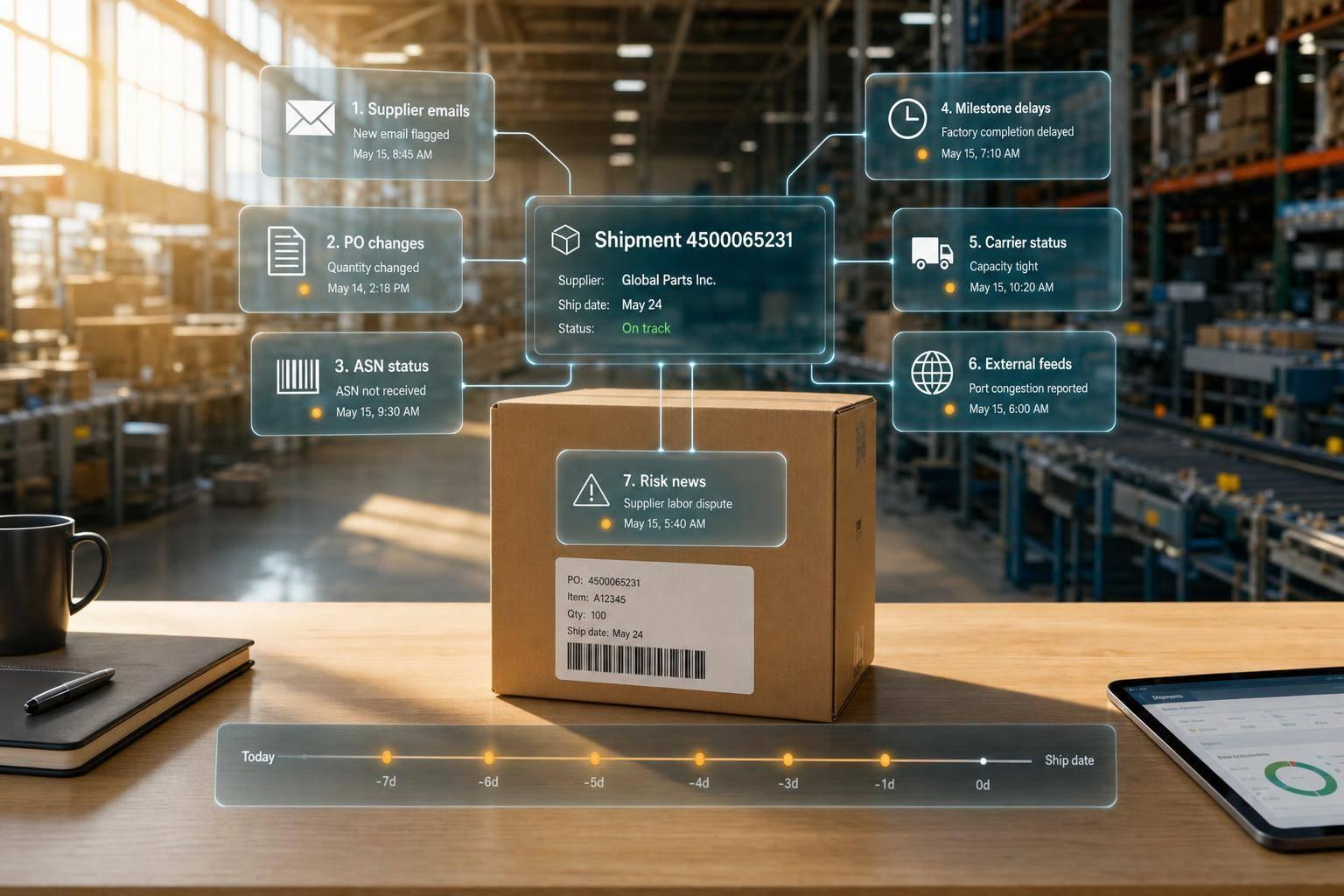 AI Automation • Aug 18, 2026 7 Supplier Delay Signals AI Spots Early 16 min read](https://tryleverage.ai/blog/supplier-delay-signals-ai-early-detection)
### See Leverage in Action
Stop chasing suppliers by email. Get real-time PO tracking and delivery visibility for your entire supply chain.
[Request a Demo](https://tryleverage.ai/request-a-demo)
#### Works with your ERP
Epicor, Infor, SAP, NetSuite, Microsoft Dynamics, and more. No EDI or supplier portal required.
[](https://tryleverage.ai)
Leverage AI delivers an end-to-end supply chain visibility platform powered by artificial intelligence that enables teams to ensure on-time delivery, in-full completion, within-budget costs, and high-quality standards.
Copyright © 2026 LVRG, Inc.
- Platform
- [CONNECT: Integrations](https://tryleverage.ai/integrations)
- [PARSE: Document Parsing](https://tryleverage.ai/document-parsing)
- [MEASURE: Supplier Performance](https://tryleverage.ai/supplier-performance)
- [PAY: Trade Finance](https://tryleverage.ai/payments)
- [ENGAGE: PO Automation](https://tryleverage.ai/purchase-order-automation)
- [TRACK: Shipments](https://tryleverage.ai/shipment-tracking)
- [COPILOT: AI Agents](https://tryleverage.ai/artificial-intelligence)
- Case Studies
- [Manufacturing](https://tryleverage.ai/case-study-manufacturing)
- [Distribution](https://tryleverage.ai/case-study-distribution)
- [Pharma & Biotechnology](https://tryleverage.ai/case-study-pharma-biotechnology)
- [Food Production](https://tryleverage.ai/case-study-food-production)
- [Furniture](https://tryleverage.ai/case-study-furniture)
- [Supplements](https://tryleverage.ai/case-study-supplements-manufacturing)
- [Packaging](https://tryleverage.ai/case-study-packaging-manufacturing)
- [Automative Parts Distributor](https://tryleverage.ai/case-study-auto-parts-distributor)
- [Commercial Equipment](https://tryleverage.ai/case-study-commercial-equipment)
- [Wood Processing Equipment](https://tryleverage.ai/case-study-wood-processing-equipment)
- Resources
- [Security & Trust](https://tryleverage.ai/security)
- [Terms of Service](https://tryleverage.ai/terms)
- [Privacy Policy](https://tryleverage.ai/privacy)
- [Vulnerability Disclosure Policy](https://tryleverage.ai/vdp)
- Company
- [Our Story](https://tryleverage.ai/our-story)
- [Podcast](https://tryleverage.ai/podcast)
- [Blog](https://tryleverage.ai/blog)
- [Careers](https://tryleverage.ai/careers)
- [Partners](https://tryleverage.ai/partners)
- [Contact Us](https://tryleverage.ai/contact)
-
-
-
```json
{
"@context" : "https://schema.org",
"@type" : "BlogPosting",
"author" : {
"@type" : "Person",
"name" : "Elizabeth Anderson",
"url" : "https://tryleverage.ai/blog/author/elizabeth-anderson"
},
"dateModified" : "2026-05-14T11:39:52.227Z",
"datePublished" : "2026-05-14T11:39:52.000Z",
"headline" : "Predictive Alerts Cut Supplier Delays 40%",
"image" : [ "https://assets.seobotai.com/cdn-cgi/image/quality=75,w=1536,h=1024/tryleverage.ai/69f7aed874a8318574a4ce79-1777841794868.jpg" ],
"mainEntityOfPage" : {
"@id" : "https://tryleverage.ai/blog/predictive-alerts-reduce-supplier-delays-40-percent",
"@type" : "WebPage"
},
"publisher" : {
"@type" : "Organization",
"logo" : {
"@type" : "ImageObject",
"url" : "https://tryleverage.ai/hubfs/Logo%20+%20Name%20Dark.png"
},
"name" : "Leverage AI"
}
}
```
```json
{
"@context" : "https://schema.org",
"@type" : "Organization",
"contactPoint" : {
"@type" : "ContactPoint",
"contactType" : "sales",
"telephone" : "+1-929-470-3086"
},
"description" : "AI-powered purchase order automation and supplier performance platform for manufacturers and distributors.",
"logo" : "https://tryleverage.ai/hubfs/leverage-logo-dark.png",
"name" : "Leverage AI",
"url" : "https://tryleverage.ai"
}
```
```json
{
"@context" : "https://schema.org",
"@type" : "FAQPage",
"mainEntity" : [ {
"@type" : "Question",
"acceptedAnswer" : {
"@type" : "Answer",
"text" : "Predictive alerts require accurate, real-time data from multiple systems. Core inputs include current inventory levels, PO statuses, shipment tracking, supplier performance history, and lead time trends. External signals like weather, port congestion, and geopolitical events add additional predictive signal."
},
"name" : "What data do predictive alerts need to work well?"
}, {
"@type" : "Question",
"acceptedAnswer" : {
"@type" : "Answer",
"text" : "In practice, AI-powered delay prediction can achieve up to 80% accuracy for lead-time disruptions, giving teams actionable early warnings with enough lead time to reroute, expedite, or adjust production schedules before the impact reaches the floor."
},
"name" : "How accurate are delay predictions in real operations?"
}, {
"@type" : "Question",
"acceptedAnswer" : {
"@type" : "Answer",
"text" : "Confirm the issue and assess severity. Review real-time data for delivery delays or capacity challenges, then prioritize response based on order value and downstream impact. Contact the supplier within four hours. Evaluate alternatives such as backup suppliers, expedited shipping, or production schedule adjustments."
},
"name" : "What should my team do first when an alert fires?"
}, {
"@type" : "Question",
"acceptedAnswer" : {
"@type" : "Answer",
"text" : "Yes. Leverage AI connects to all major ERP platforms including SAP, Oracle NetSuite, Microsoft Dynamics 365, Epicor, and Infor through API integrations. Field mapping is automatic, and most teams are live in under 90 minutes without custom development or IT involvement."
},
"name" : "Does predictive alert software work with ERPs like Epicor, Infor, SAP, or NetSuite?"
}, {
"@type" : "Question",
"acceptedAnswer" : {
"@type" : "Answer",
"text" : "ERP exception reports tell you what already happened. Predictive alerts tell you what is about to happen, typically 24 to 48 hours in advance, by combining internal PO and supplier data with external signals like weather, port delays, and supplier financial health."
},
"name" : "How is predictive alerting different from standard ERP exception reporting?"
}, {
"@type" : "Question",
"acceptedAnswer" : {
"@type" : "Answer",
"text" : "Most teams see measurable improvement within 30 to 90 days. A mid-sized U.S. manufacturer reduced their delay rate from 18% to 10.8% in 90 days, a 40% improvement, and saved $120,000 in expedited shipping costs in the same period."
},
"name" : "How long does it take to see results after implementing predictive alerts?"
}, {
"@type" : "Question",
"acceptedAnswer" : {
"@type" : "Answer",
"text" : "For mid-market manufacturers ($50M to $200M revenue), typical ROI includes $50,000 to $120,000 annually in avoided expediting costs, 30% improvement in on-time deliveries, and 50% reduction in buyer time spent on manual follow-up. Most customers recover their investment in under six months."
},
"name" : "What is the ROI of predictive alert software for mid-market manufacturers?"
} ]
}
```