Contract Compliance in Supplier Deals: Guide 2026
.png?width=40&height=40&name=julie-miller-square%20(1).png)
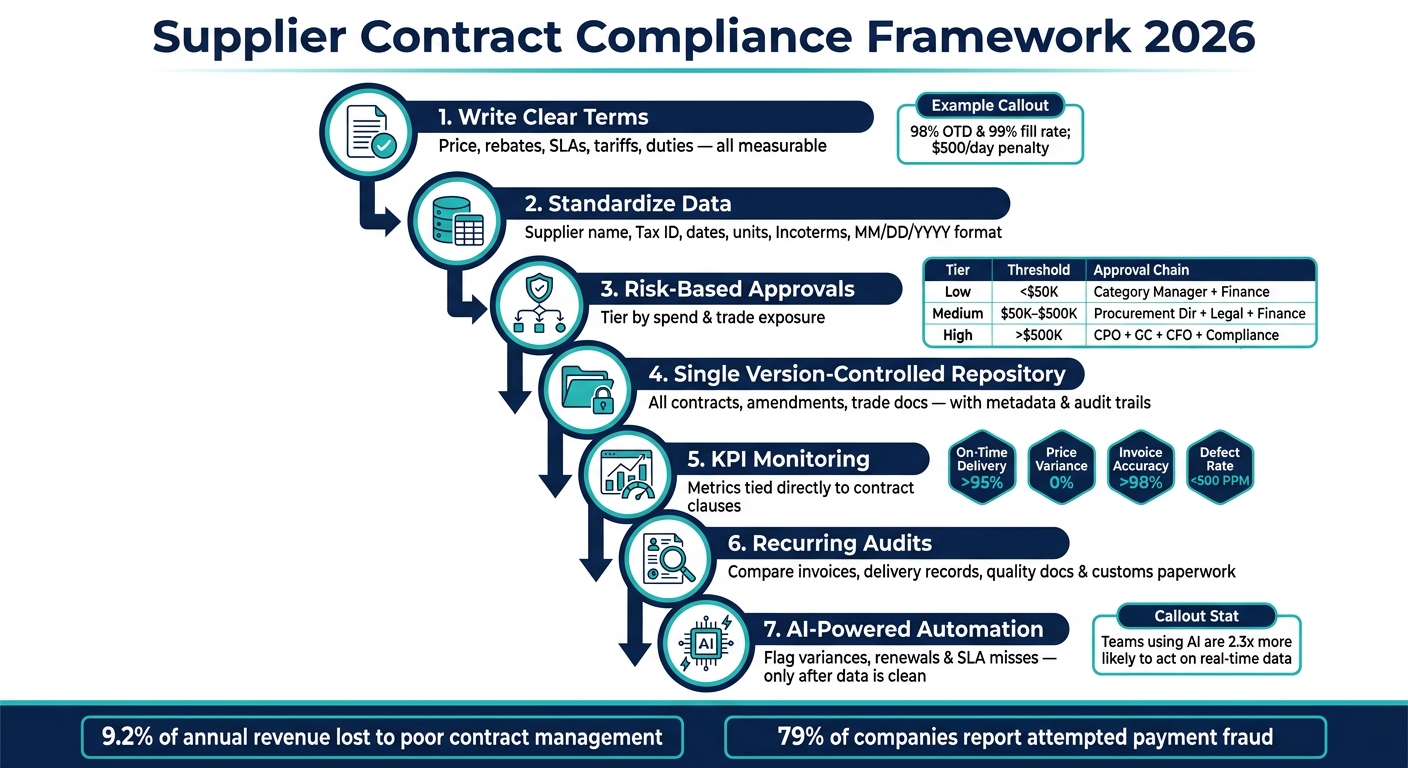
Weak supplier contract controls can drain margin fast. In plain terms, contract compliance means making sure your prices, delivery dates, quality targets, trade rules, and approvals match what you signed - because poor contract management can cost companies 9.2% of annual revenue, and 79% report attempted payment fraud.
TL;DR: If I want supplier contracts to hold up in 2026, I need clean contract data, clear terms, risk-based approvals, one version-controlled record, and KPI checks tied to the contract. I can use AI to flag price, delivery, and document issues early - but only after my data and workflows are set.
If I boil the article down, these are the main points:
- Write clear terms for price, rebates, SLAs, tariffs, and duties
- Standardize data like supplier name, Tax ID, dates, units, and Incoterms
- Route approvals by risk instead of sending every deal through the same path
- Keep one controlled record for contracts, amendments, and trade documents
- Track supplier performance with metrics tied to contract clauses
- Audit often to catch missed rebates, billing errors, and shipping issues
- Use AI after cleanup to flag variances, renewals, and SLA misses
Put simply: a signed contract does not protect me by itself. Checking the data, enforcing the terms, and reviewing exceptions on time is what keeps supplier deals in line.
Supplier Contract Compliance Framework 2026: 7 Steps to Protect Margin
Build the Contract Foundation: Data, Terms, and Trade Clauses
Standardize contract data and clause libraries
Every supplier contract should start with standardized data, clear terms, and direct trade clauses. At a basic level, that includes the legal business name, registered address, Tax ID (TIN/EIN), beneficial ownership, and supplier due-diligence data. Then comes the business side: effective date, renewal date, notice period, SKU scope, lead times, payment terms, and Incoterms.
For U.S. teams, formatting consistency matters more than people think. Use MM/DD/YYYY for dates, USD for pricing, and spell out product or packaging units like pallets and master cartons. Small formatting gaps can turn into big problems when teams review, approve, or enforce contract terms.
It also helps to keep a central clause library with pre-approved legal and trade compliance language. That library should cover areas like indemnity, data privacy (CCPA), and ESG requirements.
Define supplier terms with clear, measurable commercial rules
If a contract term is vague, it’s hard to enforce. Each supplier obligation should tie to a measurable threshold.
Unit pricing should state the exact USD price per SKU. If rebates apply, define the volume tiers by threshold and percentage. Payment terms like Net 30 or Net 60 should connect directly to payment execution, so early-payment discounts trigger from those terms without confusion.
The same goes for SLAs. On-time delivery, fill rate, and defect limits need exact targets and exact consequences. For example:
"98% on-time delivery and 99% fill rate; $500 USD penalty per day of delay"
That language is enforceable. Phrases like best efforts leave too much room for debate.
Tariff pass-through rules should be just as specific. Spell out how duty increases are shared and when either side can ask for a pricing review.
Write tariff, customs, and trade compliance clauses clearly
Trade clauses often break down because they sound complete but skip the parts that matter. A line like "Supplier pays all shipping costs and duties" may look clear at first glance. In practice, it leaves open key questions. Who classifies the goods? Who provides the Harmonized System (HS) code? Who declares country of origin? What happens if tariff rates change in the middle of the contract?
Strong trade clauses assign each task directly. The supplier should provide accurate HS codes, country of origin declarations, and customs documents for every shipment. Supplier due diligence should also cover sanctions screening, PEP checks, and anti-bribery rules such as the FCPA.
And those duties shouldn’t sit on trust alone. They need approval trails and audit records. When contract data is standardized and clauses are written with precision, approval routing and document control become enforceable instead of guesswork.
sbb-itb-b077dd9
Design Approval Workflows and Document Governance
Set approval paths by spend, risk, and trade exposure
Use your clause library to send each contract to the right reviewers before signature. The best setup is to tier approvals by contract value, supplier criticality, and trade, sanctions, or country risk.
A low-spend domestic supplier on standard terms does not need the same level of review as a high-value vendor working across several countries with more complex trade exposure. That difference matters. If every contract follows the same path, teams waste time on low-risk work and miss the contracts that need a closer look.
Give procurement, legal, finance, compliance, and operations a clear approval scope. Each group should know exactly what it owns. Set approval SLAs for every stage so contracts don’t get stuck in someone’s inbox. Most of all, align the approval path with the clauses that carry the highest financial or trade risk.
Create retention rules and version-controlled repositories
Every executed contract, amendment, pricing update, and trade document should live in one governed repository with metadata, version control, and access controls. That gives you an audit-ready record.
Retention periods should be set by risk tier, not left up to individual teams. Here’s a simple way to apply that rule across the board:
| Risk Level | Contract Value (ACV) | Required Approvers | Docs | Retention |
|---|---|---|---|---|
| Low | <$50k | Category Manager, Finance | Standard Template, Tax ID | 7 Years |
| Medium | $50k - $500k | Procurement Dir, Legal, Finance | Custom Clauses, Insurance Certs, ESG Disclosure | 10 Years |
| High | >$500k | CPO, General Counsel, CFO, Compliance | Full Due Diligence, InfoSec Audit, Performance Bond | Permanent / Life of Relationship + 10 Years |
Track every contract change, date it, and tie it to the approver who signed off on it. When amendments and redlines sit in email threads instead of a governed system, version conflicts pile up fast. And when audit time comes, sorting out “which file is the final one?” turns into a mess.
Use AI-enabled workflows to cut manual follow-up
Manual follow-up is where compliance often starts to slip. Use AI to route renewal, follow-up, and exception tasks on its own, log each action to the contract record, and flag missed deadlines early.
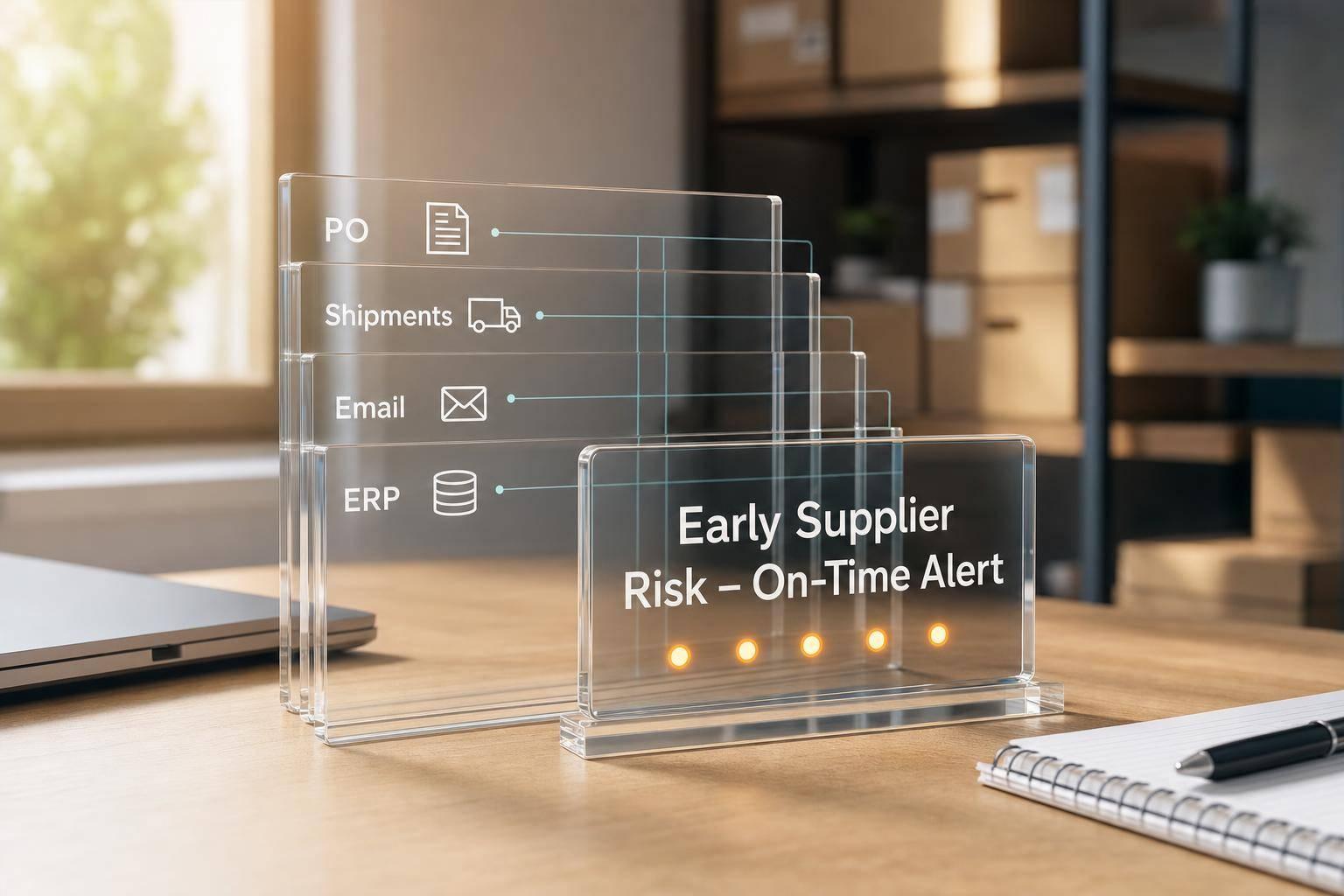
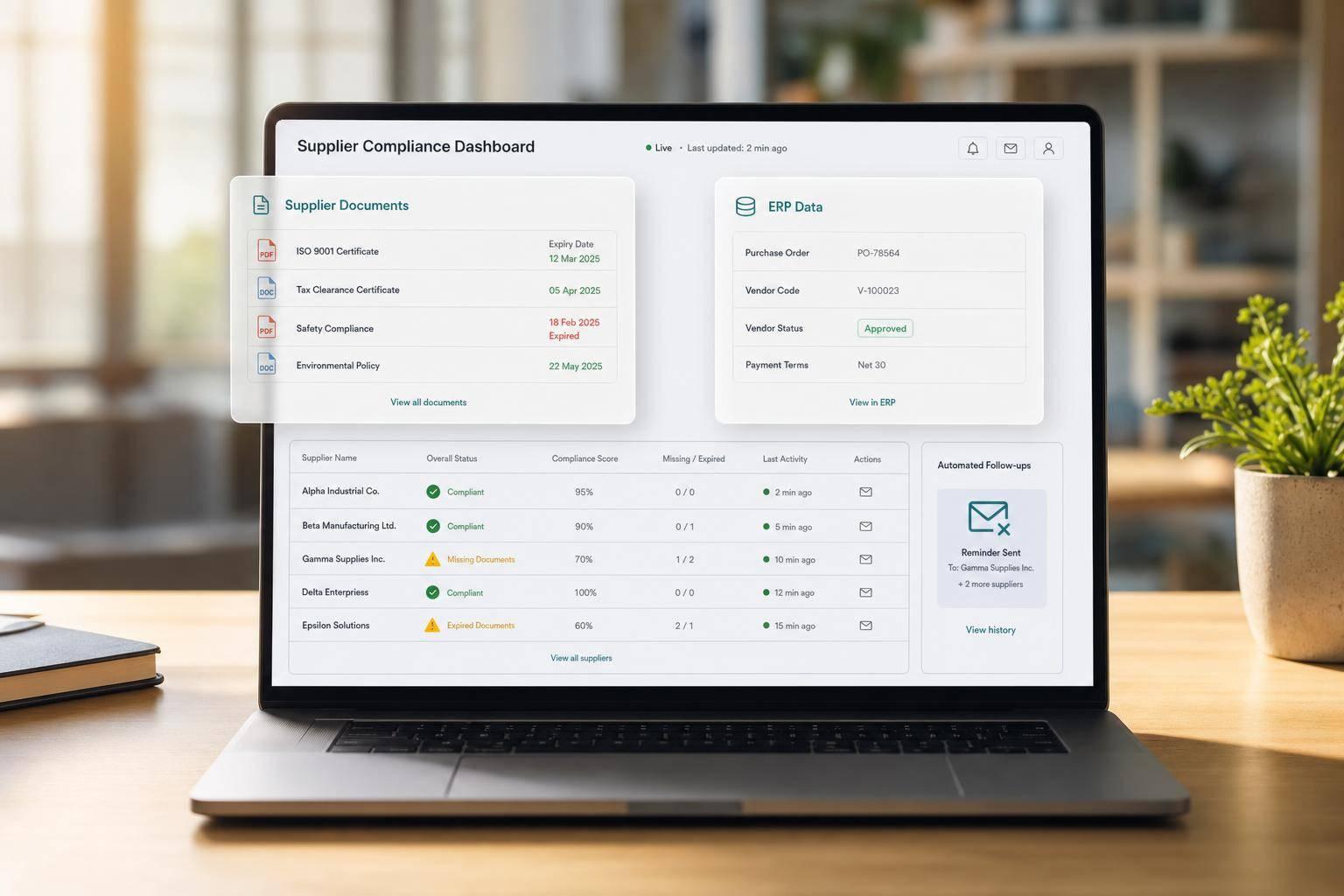
Leverage AI supports this with ERP-integrated supplier follow-up automation and real-time performance tracking. Automated alerts at 90, 60, and 30 days before contract expiration replace spreadsheet-based renewal tracking. That takes pressure off manual follow-up and brings exceptions to the surface before they turn into bigger problems.
Those records then feed audits, KPIs, and supplier scorecards. They become the working trail your team can rely on when it needs to show what happened, when it happened, and who approved it.
Uncover Millions with AI-Driven Supplier Contract Compliance & Optimization
Monitor Compliance with Audits, KPIs, and Supplier Scorecards
Once contract data and approval controls are set up, the next step is simple: check whether suppliers are doing what they signed up to do.
Choose KPIs tied directly to contract obligations
Each KPI on your compliance dashboard should link to one contract clause, one source system, and one review schedule. If a metric doesn’t connect to those three things, it’s hard to trust and even harder to use.
For a practical dashboard, keep your focus on pricing, delivery, quality, documentation, and responsiveness. Price variance shows whether suppliers are billing at the contracted rate. On-time delivery (OTD) % shows whether shipments arrive when promised. Defect rate in parts per million (PPM) tracks product quality against spec. Invoice accuracy helps catch billing mistakes before they turn into disputes. Tariff documentation completeness checks that customs and trade paperwork shows up with each shipment.
Every metric also needs a clear data source and review cadence. Without that, the dashboard turns into noise. Here’s a solid baseline for supplier compliance KPIs:
| Metric | Definition | Target | Source System | Review Frequency |
|---|---|---|---|---|
| On-Time Delivery % | % of orders received by the contract date | >95% | ERP / WMS | Monthly |
| Price Variance | Difference between invoiced price and contract rate | 0% | P2P / CLM | Weekly |
| Invoice Accuracy | % of invoices processed without disputes or errors | >98% | AP Automation | Monthly |
| Defect Rate (PPM) | Parts per million rejected during quality check | <500 PPM | Quality Management System | Quarterly |
| Critical Support Response Time | Time for supplier to respond to critical support tickets | <4 hours | Service Desk | Monthly |
| Tariff Documentation | Completeness of required customs and trade docs | 100% | TMS / GTM | Per Shipment |
| Certificate of Insurance Validity | % of suppliers with current, valid insurance certificates | 100% | Supplier Portal | Real-time |
It also helps to connect these KPIs to the incentives and penalties already written into the contract. If a metric has no effect on payment, renewal, or escalation, suppliers have little reason to change course.
Run audits and corrective action cycles
Audits are where you verify the facts. They show whether supplier reports line up with what happened on the ground.
A recurring audit cycle should compare invoices, delivery records, quality documents, and customs paperwork against contract terms. Look at those records together, not in isolation. That makes it easier to spot patterns, like a billing issue that shows up at the same time as late shipments or missing trade documents.
When you find a gap, log it with the root cause and a deadline to fix it. That record matters. It shows that internal controls are in place and working if an external auditor or regulator asks for proof.
Use AI for variance detection and supplier scorecards
AI can scan invoices, POs, and shipment records on a continuous basis and flag mismatches in price, delivery, or customs data. That gives procurement teams a way to catch problems early instead of waiting for a month-end review.
Procurement teams leveraging AI within their contract management software are 2.3x more likely to act on real-time data. That timing matters. A price variance found in week one is usually a fix. The same issue found six months later is a direct hit to margin.
ERP-connected scorecards make this process much stronger. When performance data flows straight from the ERP into the scorecard, the scorecard reflects what’s happening now, not what someone keyed in last month. That’s what turns scorecards from a static report into something teams can use day to day.
Those scorecards can then feed exception handling, renewal reviews, and automated follow-up.
Build an AI-Powered Compliance Program That Runs Consistently
Get your data and processes ready before automating
Once audits and scorecards are in place, automation can keep routine checks running every day. But there’s a catch: automate only after your contract, supplier, and transaction data is clean.
The biggest mistake is simple and costly: automating dirty data.
Before you turn on AI-driven workflows, make sure each contract includes structured metadata such as vendor name, contract type, value, and start and end dates. Your ERP, purchase order, and receiving records also need to line up. On top of that, your supplier master file should include validated legal names, tax IDs, and banking details. If those pieces are off, AI risk scoring and payment automation will produce bad outputs.
Process discipline matters just as much as data quality. Standardize your templates, clause libraries, intake, and exception routing before you automate anything. Each approval step and exception type should have one clear owner. When those categories are set and used the same way every time, AI can triage routine issues on its own and send the harder calls to the right human reviewer.
| Foundation Layer | Key Requirements | Goal |
|---|---|---|
| Data | Structured metadata, validated supplier master file, ERP-PO-receiving alignment | Clean inputs for AI processing |
| Process | Standardized templates, SLA-driven routing, intake controls | Repeatable operating model |
| Governance | Segregation of duties, role-based access, audit trails | Risk-based control and accountability |
Apply automation to renewals, pricing checks, and SLA exceptions
After the data model is stable, start with the highest-volume controls. That’s usually where manual work lets margin slip away.
Set renewal alerts at 90, 60, and 30 days before expiration. For pricing checks, use tolerance rules to auto-close variances that fall inside approved limits, then flag anything outside the accepted range for human review. It’s a plain idea, but it saves time and keeps teams focused on the issues that need judgment.
| Match Category | AI Tolerance Rule | Action |
|---|---|---|
| Price | Allow ±3% variance up to $1,000 | Auto-match |
| Quantity | Auto-approve if within ±2% of PO | Auto-match |
| Delivery Date | If ≤3 days early or late | Auto-post |
| Freight/Fees | Approve up to contracted caps | Auto-match |
For SLA exceptions and tariff-related issues, route exceptions by category and spend. That’s the whole point of automation here. Not more layers. Not more noise. Just faster control over the exceptions that matter most.
Platforms like Leverage AI support this model with ERP integration, purchase order automation, supplier performance tracking, and real-time supply chain visibility. That means procurement teams spend less time chasing data and more time resolving exceptions.
Conclusion: The controls that matter most in 2026
A compliance program that runs the same way day after day depends on a short list of non-negotiables: clean contract data, measurable supplier terms, explicit trade clauses, risk-based approval paths, disciplined document retention, regular audits, and KPI scorecards tied directly to contract obligations.
AI can strengthen compliance. But clean data and disciplined workflows still decide whether controls actually hold. When the inputs are clean and the workflows are standardized, AI can catch variances early and keep compliance moving every day.
FAQs
Where should I start fixing supplier contract compliance?
Start by fixing the structural gaps created by fragmented, siloed, manual systems. Bring all contracts into one searchable repository so you have a single source of truth.
Then clean up supplier master data, remove duplicates, update expired credentials, set clear compliance criteria, assign ownership, and connect the repository to ERP, procurement, and finance systems. That makes it much easier to automate obligation tracking and match supplier performance to contract terms.
How often should I audit supplier contract compliance?
Conduct formal supplier contract audits at least once a year. Then adjust the schedule based on risk.
For high-value or high-risk contracts, quarterly audits make sense. They can spot billing errors, missed service-level agreements, or performance gaps before those issues grow into bigger problems.
It also helps to audit right after regulatory changes or when new operational risks show up. And between scheduled reviews, automated systems can help with continuous monitoring and real-time alerts.
What can AI automate in supplier contract compliance?
AI can automate supplier contract compliance by replacing manual, periodic reviews with continuous monitoring tied to ERP data.
It can:
- extract and validate data from contracts and related documents
- track obligations, expirations, and compliance requirements
- flag non-standard clauses or performance gaps
- route approvals, alerts, and supplier follow-ups while maintaining an audit trail