Top 7 AI Tools for Supplier Collaboration
%202%20(1).png?width=40&height=40&name=20250501_1415_Professional%20LinkedIn%20Update_remix_01jt6gxkjmekavnvzsewk61z9w%20(1)%202%20(1).png)
AI tools are transforming supplier collaboration by automating routine tasks, providing real-time visibility, and predicting risks. This article highlights seven AI platforms - Leverage AI, Ivalua, Blue Yonder, SAP IBP, Oracle SCM Cloud, Kinaxis RapidResponse, and FourKites - each offering unique features like predictive analytics, ERP integration, and automated supplier communication. Choose the right tool based on your specific needs, such as PO automation, demand forecasting, or shipment tracking.
Managing suppliers is easier with AI. These tools reduce disruptions, improve efficiency, and save time by automating processes like purchase orders and supplier communication. Whether you need better visibility, predictive insights, or seamless ERP integration, this guide covers the best options available today.
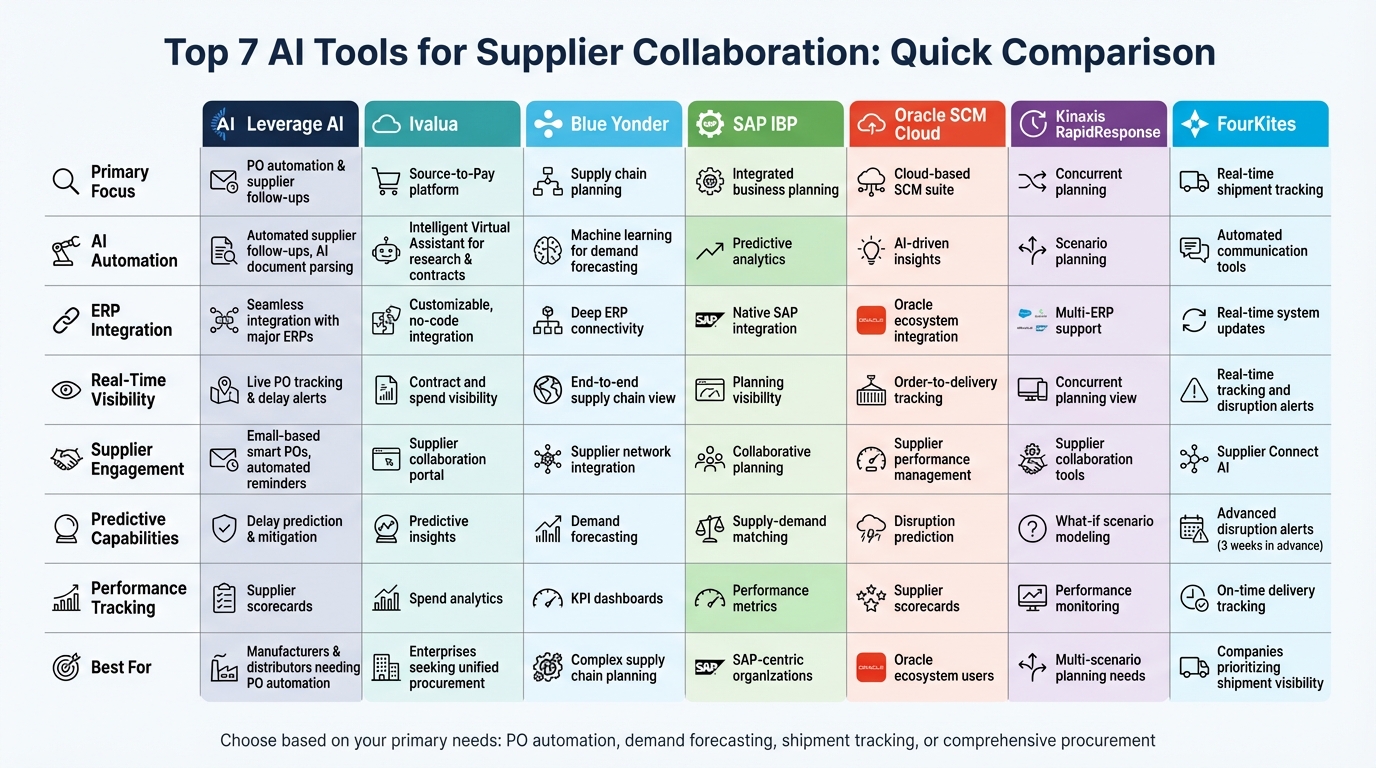
AI Supplier Collaboration Tools: Feature Comparison of Top 7 Platforms
AI Tools for Supplier Collaboration
1. Leverage AI
- Focus: Purchase order automation and supplier follow-ups.
- Key Features: Real-time PO tracking, smart digital POs, ERP integration, supplier scorecards.
- Best For: Manufacturers needing centralized supplier management.
2. Ivalua
- Focus: Source-to-pay procurement platform.
- Key Features: Supplier portals, risk monitoring, AI-driven procurement agents.
- Best For: Enterprises managing procurement across global suppliers.
3. Blue Yonder
- Focus: Supply chain planning and demand forecasting.
- Key Features: Unified trading network, machine learning for demand planning, predictive ETAs.
- Best For: Businesses handling complex supply chain operations.
4. SAP IBP
- Focus: Real-time supply chain planning.
- Key Features: Demand sensing, SAP Business Network integration, predictive analytics.
- Best For: SAP-centric organizations seeking integrated solutions.
5. Oracle SCM Cloud
- Focus: Cloud-based supply chain management.
- Key Features: AI-driven insights, supplier collaboration advisors, disruption prediction.
- Best For: Oracle ecosystem users prioritizing supply chain automation.
6. Kinaxis RapidResponse
- Focus: Scenario planning and concurrent data updates.
- Key Features: Digital twins, real-time supplier updates, multi-ERP support.
- Best For: Companies requiring advanced scenario modeling.
7. FourKites
- Focus: Real-time shipment tracking and disruption alerts.
- Key Features: Predictive analytics, automated supplier updates, digital workers.
- Best For: Businesses prioritizing shipment visibility and risk management.
Quick Comparison
| Feature | Leverage AI | Ivalua | Blue Yonder | SAP IBP | Oracle SCM Cloud | Kinaxis RapidResponse | FourKites |
|---|---|---|---|---|---|---|---|
| Primary Focus | PO automation | Procurement platform | Supply chain planning | Integrated planning | Cloud-based SCM | Scenario modeling | Shipment tracking |
| AI Automation | Supplier follow-ups | Procurement agents | Demand forecasting | Predictive analytics | AI-driven insights | Real-time planning | Automated updates |
| ERP Integration | Seamless | Customizable | Deep connectivity | SAP integration | Oracle integration | Multi-ERP support | Real-time updates |
| Real-Time Visibility | Live PO tracking | Risk and spend data | End-to-end view | Planning visibility | Order tracking | Concurrent data updates | Shipment tracking |
| Supplier Engagement | Smart POs, reminders | Collaboration portal | Supplier network | Collaborative planning | Supplier advisors | Collaboration tools | Supplier Connect AI |
AI tools like these help businesses save time, reduce risks, and improve supplier relationships. Select the right platform based on your specific challenges, whether it's automating POs, forecasting demand, or managing shipments.
sbb-itb-b077dd9
1. Leverage AI
Supply Chain Visibility
Leverage AI takes the hassle out of managing supplier data by automating real-time data collection. It pulls in supplier acknowledgments, updates on lead times, and shipment notifications, syncing everything directly into your ERP system. This eliminates the need for manual data entry and ensures buyers always have the latest updates on their orders across the entire supplier network.
The platform acts as a centralized hub where manufacturers can track all open purchase orders in one place. Forget juggling endless spreadsheets and email chains - Leverage AI gives teams a clear dashboard to see which orders are on schedule, which suppliers have requested changes, and where delays might crop up.
"We're now able to keep our customers happier because we can finally now answer their questions about where their stuff is." - Erin Purvis, Supply Chain, Blu Dot
Supplier Collaboration Features
Leverage AI simplifies supplier interactions with smart digital POs sent directly to suppliers' email inboxes. Suppliers can acknowledge orders, update delivery dates, and share shipment details - all without logging into a separate portal. Customizable, priority-based reminders ensure critical tasks are addressed promptly.
When suppliers propose changes to dates, costs, or quantities, buyers can review and approve these updates using an exception dashboard. This streamlined process creates a single source of truth, which flows back into the ERP system. The result? Fewer miscommunications and less duplicate data entry.
Thanks to seamless ERP integration, these features work effortlessly within your existing systems.
ERP Integration Capabilities
Leverage AI connects directly to your ERP system through API integration, automating the flow of purchase order and inventory data without requiring additional middleware. The platform’s dedicated integration team makes setup quick and efficient, even for older, legacy systems.
User data from 2026 shows impressive results: 74% of users reported increased revenue within the first three months of implementation, while 96% saw a significant drop in out-of-stock issues. Plus, with access to a network of thousands of pre-integrated suppliers, manufacturers can start collaborating almost immediately, bypassing lengthy onboarding processes.
This tight ERP integration lays the groundwork for automating processes and delivering actionable insights.
Automation and AI-Driven Insights
Leverage AI doesn’t just streamline processes - it takes them to the next level. The platform automates follow-ups and report generation while using AI-driven scorecards to track supplier performance metrics like delivery accuracy and compliance. Buyers can set up automated reminders tailored to supplier priority or item criticality, ensuring high-stakes orders get the attention they deserve.
"Leverage is a total game-changer for us. I can't believe we managed our supply chain without this level of visibility before." - Eric Swope, COO, Buckle Down
The AI-powered insights go deeper, helping teams spot trends in supplier behavior and predict delays before they disrupt production. This proactive approach to supplier management is crucial for today’s supply chain demands. Additionally, 89% of users say the platform has helped them reduce future headcount needs, allowing teams to focus on strategic decisions rather than tedious manual tasks.
3 Best AI Tools In Procurement & Supply Chain (2026)
2. Ivalua
Ivalua is designed to meet the evolving demands of modern supply chains by combining extensive visibility, streamlined communication, and integrated automation tools.
Supply Chain Visibility
Ivalua delivers a 360-degree view of supplier risk and performance, using real-time risk signals and inventory tracking to provide full-network visibility. With connections to over 1 million suppliers, the platform ensures seamless monitoring across the supply chain. Automated alerts notify users of changes in financial, operational, or compliance statuses, helping to mitigate potential disruptions.
A standout feature is its multi-tier visibility, which allows communication with direct suppliers and sub-tier partners. Through bulk email campaigns, users can track engagement metrics, such as who has opened messages or taken action. This transparency fosters better alignment and reduces the risk of supply chain interruptions.
Supplier Collaboration Features
Ivalua simplifies collaboration with its Message Center, which includes built-in chat functionality for real-time discussions between teams and suppliers. Users can share files, tag colleagues, and assign tasks - all without needing to switch platforms. The supplier portal speeds up onboarding, often completing the process in minutes, and supports connections through EDI, XML, email, and Excel.
The platform's Forecast Collaboration feature enables users to share demand forecasts with suppliers, allowing them to confirm capacity and avoid bottlenecks. Additionally, the Planned Order Collaboration tool automates supply chain transactions, reducing errors and cycle times during order amendments.
"The Ivalua platform enables us to manage all major sourcing activities [direct and indirect] in one place, driving standardization and supplier data harmonization across our global businesses." - Michael Stietz, SVP & Chief Procurement Officer, Körber
For new product launches, the NPI (New Product Introduction) module supports innovation by enabling direct materials quoting, Bill of Materials management, and secure sharing of sensitive design documents. A 2025 Forrester study highlights Ivalua's financial impact, reporting a 393% ROI within three years, an average of $32 million in benefits, and a payback period of under six months.
These features integrate seamlessly with backend systems, ensuring smooth data flow throughout the organization.
ERP Integration Capabilities
Ivalua's Integration Hub comes equipped with pre-built connectors for SAP, Oracle, and Microsoft, using APIs, ETL, and EAI for real-time data orchestration. Its built-in integration layer eliminates the need for third-party middleware, reducing both complexity and costs. The platform is particularly effective for organizations managing procurement workflows across multiple ERP systems.
"Ivalua helps us to enhance the automation of data exchange and to share purchasing repositories and data in a user-friendly tool." - Benjamin Hulot, VP Purchasing Performance, Veolia
The results speak for themselves: Ivalua boasts over 90% supplier enablement rates, onboarding speeds 80% faster than legacy systems, and a customer retention rate exceeding 95%. These metrics underscore the platform's effectiveness in connecting enterprise systems with supplier networks.
Automation and AI-Driven Insights
Ivalua leverages advanced AI-driven automation to transform procurement processes. With over 30 pre-built Procurement AI Agents available across the source-to-pay spectrum, the platform simplifies complex tasks. For example, the Intelligent Virtual Assistant (IVA) can summarize contracts, draft mass supplier communications, and extract specific data points from documents. The Sourcing Supplier Finder agent streamlines supplier invitations by analyzing both internal and market data, creating more competitive sourcing events.
Other tools, like the RFx Analysis agent, automate bid comparisons and provide standardized award recommendations. Meanwhile, the Supplier Improvement Plan agents generate actionable plans based on performance and risk data. All AI agents operate from a unified data model, ensuring consistency and accuracy.
"Ivalua's AI platform enables a new operating model: AI Agents automate reactive work, so people can focus on the strategy setting and relationship building that matters." - Ivalua
For tailored solutions, the platform's Agent Factory allows users to build, test, and deploy custom no-code AI agents that fit specific business needs. With research showing that 71% of procurement time is spent on manual tasks, these AI tools are designed to free up valuable time for strategic activities.
3. Blue Yonder
Blue Yonder addresses the challenge of decision fatigue in supplier collaboration. With 85% of supply chain leaders experiencing decision-related stress - and making 10 times more daily decisions than they did a decade ago - the need for smarter tools is clear. By 2030, industrial manufacturing is expected to generate an overwhelming 4.4 zettabytes of data, underscoring the importance of AI solutions to manage this information deluge.
Supply Chain Visibility
The platform’s Unified Trading Network connects suppliers, customers, and carriers into one streamlined system, eliminating the inefficiencies caused by disconnected tools. Its Supply Chain Command Center offers a customizable dashboard where suppliers can track purchase orders, evaluate On-Time In-Full (OTIF) trends, and monitor carrier performance in real time. With telematics and IoT monitoring, Blue Yonder also enables asset tracking, including cold-chain logistics, and provides predictive insights to anticipate delays. This allows suppliers to focus on exceptions rather than micromanaging every shipment.
Supplier Collaboration Features
Blue Yonder facilitates shared forecasting and inventory planning, helping suppliers and retailers align production with demand. Machine learning models further enhance the process by analyzing supplier risks and predicting environmental impacts, giving businesses the tools to create more resilient supply networks. For U.S.-based suppliers, the Retail Network US service centralizes supply, demand, and logistics management, covering everything from Advanced Shipping Notices to freight financials.
"AI agents now automate routine tasks - shrinking data analysis from hours to minutes, surfacing insights autonomously and synchronizing workflows across departments."
- Danielle Strouther, Blog Author, Blue Yonder
The platform’s AI-driven engines can dynamically reroute shipments during disruptions, while predictive ETAs ensure all stakeholders stay informed. Blue Yonder’s leadership in supply chain innovation has been recognized by its 12th designation as a Leader in the 2025 Gartner® Magic Quadrant™ for Supply Chain Planning Solutions.
ERP Integration Capabilities
Blue Yonder’s integration capabilities make it easy to connect with existing systems. Using a common API set and pre-built data egress, the platform integrates seamlessly with legacy ERP systems and third-party applications. This synchronization spans forecasting, fulfillment, warehousing, and transportation across multiple channels.
"The Blue Yonder Platform synchronizes forecasting, fulfillment, warehousing, transportation, labor and delivery across multiple channels, reducing the latency and inefficiencies created by disjointed systems."
- Blue Yonder
These integration features allow companies to scale operations without overhauling their infrastructure. Additionally, the platform’s unified security framework simplifies compliance and streamlines threat testing through single authentication and authorization.
Automation and AI-Driven Insights
Blue Yonder combines predictive, generative, and agentic AI to turn raw data into actionable recommendations. Generative AI can automate nearly 29% of supply chain tasks, while AI-driven scenario modeling reduces simulation times from hours to mere minutes. Gartner predicts that by 2028, 70% of sourcing events will involve AI, with 25% functioning entirely autonomously by 2027.
The platform focuses on enhancing human decision-making rather than replacing it. In fact, 93% of business leaders agree that human oversight remains critical in AI-powered decisions. Blue Yonder advises businesses to start implementing AI in areas tied to financial performance, such as demand planning, inventory turnover, and OTIF rates, to maximize ROI.
"AI amplifies human judgment rather than replacing it, with 93% of business leaders believing humans should be involved in AI-driven decisions."
- Danielle Strouther, Blog Author, Blue Yonder
4. SAP Integrated Business Planning (IBP)
SAP IBP is trusted by over 1,000 companies for real-time supply chain planning, powered by SAP HANA. Its success is reflected in accolades like TrustRadius's "Buyer's Choice" and "Top Rated" awards, showcasing its ability to manage intricate supplier networks.
Supply Chain Visibility
The platform's Intelligent Visibility feature integrates data from SAP S/4HANA, SAP Digital Manufacturing Cloud, and SAP Transportation Management, offering a comprehensive view of the supply chain. Meanwhile, the SAP Supply Chain Control Tower employs machine learning to filter out unnecessary alerts, focusing only on critical supplier-related issues.
"Intelligent visibility provides a holistic view of your digital supply chain, as it connects the dots across different domains."
- SAP
Organizations like Microsoft have leveraged SAP IBP's predictive planning to reduce inventory levels while addressing supply chain risks through actionable insights. Similarly, BYK adopted the platform to enhance data accuracy and transparency, enabling more precise demand planning by understanding shifting market needs. This interconnected visibility sets the stage for the real-time supplier collaboration discussed next.
Supplier Collaboration Features
SAP IBP builds on its visibility capabilities to enable dynamic collaboration with suppliers. Through integration with the SAP Business Network, companies can share planning constraints and alerts directly with suppliers and contract manufacturers in real time. Buyers send Product Activity Messages containing forecasts, while suppliers respond with Product Replenishment Messages to confirm commitments. An IDC study highlighted that customers using SAP Business Network achieved a three-year ROI of 404%.
The platform's Demand Sensing feature uses algorithms, such as gradient boosting, to incorporate external market signals, helping suppliers adjust production schedules to meet short-term demand fluctuations. Additionally, Procedure Playbooks document best practices for handling common supplier disruptions, ensuring consistent and efficient responses across the organization.
ERP Integration Capabilities
SAP IBP leverages tools like SAP CI-DS and CI-SDI alongside OData and REST APIs to streamline data exchange in formats such as cXML and JSON. Integration is monitored using SAP Solution Manager, which oversees exceptions, application logs, and job statuses across both cloud and on-premise setups.
Automation and AI-Driven Insights
The platform incorporates advanced AI tools like the Joule Copilot for conversational AI-driven recommendations and Joule Agents, which autonomously handle complex workflows. Machine learning identifies and corrects data inconsistencies, improving planning accuracy. These AI tools play a key role in supplier collaboration by addressing potential issues before they escalate.
"Machine learning and AI can make your life easier and help you to optimize your supply chain planning, to drive planning accuracy and automation."
- Ina Glaes, Product and Topic Expert, SAP
For example, Roca Group used the Joule Copilot to enhance visibility and support its innovation and sustainability efforts. ZF Friedrichshafen unified multiple ERP systems into a single platform for global demand planning, leveraging AI-driven tools. The platform’s What-if Simulations further empower planners to test scenarios - like supplier capacity changes - in minutes, significantly reducing time compared to traditional methods.
5. Oracle SCM Cloud
Oracle SCM Cloud builds on AI-driven supply chain strategies by offering real-time, integrated insights. Recognized as a Leader in the 2026 Gartner Magic Quadrant for Source-to-Pay Suites, the platform emphasizes seamless supplier collaboration across the supply chain.
Supply Chain Visibility
Oracle SCM Cloud leverages AI to enhance visibility across supply chain operations. Its predictive tools forecast shipment transit times and flag at-risk orders before issues arise. The platform also monitors supplier risks, such as financial stability, compliance, capacity, ESG factors, and cybersecurity, providing early warnings to support proactive decisions.
Features like Lead Time Insights analyze real transactional data, helping businesses refine supplier performance and adjust delivery timelines. Paul Woodward, Global Vice President of Oracle Retail Products, highlighted how these insights empower retailers to manage complex vendor relationships and mitigate risks effectively.
These capabilities enable more efficient supplier collaboration and risk management.
Supplier Collaboration Features
Oracle enhances supplier interactions through role-specific AI tools. The Supply Chain Collaboration Advisor offers 24/7 chat access for updates on forecasts, commitments, and production, while the Supplier Portal Advisor addresses policy and procedural queries, reducing the need for support tickets .
"Our new AI agents for supply chain management help ease the administrative burden by streamlining workflows and automating routine tasks to enable greater accuracy and efficiency, smarter decision-making, and ultimately, a more agile and responsive supply chain." - Chris Leone, Executive Vice President of Applications Development, Oracle
The Autonomous Sourcing Agent simplifies competitive bidding for high-volume, low-dollar purchases by identifying requisitions, preparing sourcing events, and inviting suppliers. For onboarding new suppliers, the Manufacturer Onboarding Advisor evaluates candidates against risk and compliance criteria, speeding up the vetting process.
ERP Integration Capabilities
Oracle SCM Cloud integrates directly with Oracle Fusion Cloud ERP, creating seamless workflows for tasks like purchase order creation, invoice processing, and supplier payments. The Oracle Business Network provides a preintegrated platform for B2B transactions with global partners, while the Collaboration Messaging Framework automates B2B messaging without extra licensing fees. REST web services enable real-time access for custom integrations, supporting project-based supply chains with precise cost allocation and invoicing.
This integration streamlines processes and enhances automation across the supply chain.
Automation and AI-Driven Insights
Generative AI tools in Oracle SCM Cloud streamline tasks like drafting negotiation summaries, cover pages, and personalized supplier communications, reducing manual input for RFQs and contracts. The Purchase Order to Sales Order Converter Agent extracts data from PDFs to minimize errors, while AI-powered spend classification organizes requisitions, purchase orders, invoices, and expenses for in-depth analysis.
The platform also tracks environmental data, such as greenhouse gas emissions from supplier invoices, aiding in regulatory reporting. With a community of over 200,000 members on Oracle Cloud Customer Connect, users have access to a robust network for sharing knowledge and best practices.
6. Kinaxis RapidResponse
Kinaxis Maestro, previously known as RapidResponse, offers a "supply chain data fabric" that consolidates both internal and external data into a single, unified source. This approach addresses the common challenge of fragmented views caused by teams working across multiple systems.
Supply Chain Visibility
The platform employs concurrent planning, a method that updates all relevant data in real time, ensuring everyone operates with the most current information. When changes occur - like supplier schedule updates - they are instantly reflected across the entire network. This eliminates outdated data and minimizes decision-making delays.
AI-powered Control Towers further enhance visibility by breaking down silos between different functions and enabling collaboration across organizational boundaries. Additionally, users can create unlimited digital twins to simulate potential scenarios. These simulations allow teams to test how supplier-related changes might affect the supply chain before making any commitments. This real-time, unified view fosters more efficient supplier interactions.
Supplier Collaboration Features
Kinaxis includes External Orchestrator agents designed to coordinate and escalate actions with suppliers. A built-in responsibility matrix identifies the key stakeholders for each decision, provides them with the necessary context, and logs decisions for future reference.
The platform also supports natural language interactions, allowing planners to engage without needing advanced technical expertise. This makes it easier for teams to collaborate on complex supplier scenarios without getting bogged down by the platform's mechanics.
ERP Integration Capabilities
Kinaxis RapidResponse is ERP-agnostic, meaning it can connect to multiple internal and external data sources simultaneously without duplicating data. This capability is especially useful for organizations using multiple ERP systems or working with suppliers on various platforms. By bridging these gaps, the system creates a unified view, even across fragmented IT environments, enabling advanced AI-driven insights.
Automation and AI-Driven Insights
Maestro agents, embedded within the concurrent planning model, utilize machine learning, optimization techniques, and heuristics to address supply chain challenges. These agents rely on the most up-to-date enterprise-wide data, avoiding issues caused by outdated snapshots.
"Integrating AI with humans is the only way to navigate what I see as really turbulent waters ahead. We have AI and humans, each doing what they do best." - Dr. Nada Sanders, Distinguished Professor, Northeastern University
Through the Maestro Agent Studio, users can create custom AI agents tailored to specific supplier priorities and decision-making processes. These agents can detect disruptions, propose solutions, and simulate outcomes in real time, empowering planners to act quickly during critical moments. This seamless integration of AI and human decision-making strengthens supplier collaboration by delivering timely, actionable insights.
7. FourKites
FourKites specializes in real-time shipment tracking and AI-powered automation. But it doesn’t stop at monitoring shipments - it dives deeper, analyzing the entire supply chain to predict disruptions up to three weeks in advance. These early insights give teams the chance to address potential issues with suppliers before they impact production.
Supply Chain Visibility
One standout feature of FourKites is its Order Twin Technology, which creates a digital replica for every order. This system maps out the intricate connections between inventory, production schedules, and customer requirements. If a supplier delay occurs, the platform immediately identifies which customers or production lines will be affected and calculates the financial impact of the disruption.
A major challenge in supply chain management is the loss of critical supplier updates - 90% of these updates often get buried in emails, documents, or chats. FourKites’ AI steps in to process these unstructured communications, turning scattered information into actionable insights without requiring manual input.
By offering real-time visibility and seamless integration with existing systems, FourKites simplifies communication and ensures teams have the tools they need to act quickly.
Supplier Collaboration Features
With Supplier Connect AI, FourKites automates time-consuming supplier communications. The platform employs AI-powered Digital Workers, named Sam and Tracy, who operate 24/7. Sam focuses on supplier collaboration, including onboarding and collecting updates, while Tracy manages tracking and exception coordination.
Unilever’s North America Logistics team adopted Tracy in early 2026. Within just four weeks, they saw improvements in exception management and tracking accuracy.
Shwetha Balagali, Senior Manager of Logistics North America at Unilever, shared: "Co-innovating and implementing the digital worker, Tracy, has helped Unilever teams in the U.S. make our supply chain management more efficient. Within four weeks, we observed notable improvements to exception management and tracking quality".
The results speak for themselves: companies using FourKites have cut manual coordination time with suppliers by 80% and achieved 96% on-time delivery rates.
A global electronics manufacturer stated: "Supplier Connect AI has revolutionized how we work with our suppliers. We've eliminated 90% of manual communications and can prevent disruptions weeks before they impact production".
ERP Integration Capabilities
FourKites ensures data consistency across organizations by automatically updating internal systems in real time. The platform integrates shipment data with order and production schedules, offering a unified view. This synchronization has allowed users to reduce buffer stock by 22%.
Automation and AI-Driven Insights
FourKites goes beyond basic tracking by using predictive intelligence to analyze shipment data, supplier behavior, and order patterns. This helps identify risks before they escalate. The platform doesn’t just highlight potential issues - it also calculates the financial impact and suggests corrective actions through its digital workers.
By automating these processes, FourKites saves employees 2-3 hours daily, enabling them to focus on building stronger supplier relationships rather than handling routine tasks.
FourKites stands out for its ability to turn predictive insights into proactive, efficient supplier management, reshaping how companies handle supply chain challenges.
Feature Comparison Table
When deciding on an AI tool for supplier collaboration, it’s crucial to weigh your specific needs, budget, and existing infrastructure. Each platform offers distinct strengths, whether it’s predictive analytics, real-time visibility, or automated communication.
Below is a table that breaks down key features like ERP integration, AI automation, supplier engagement, and more. Use it to quickly evaluate which platform aligns best with your business priorities.
| Feature | Leverage AI | Ivalua | Blue Yonder | SAP IBP | Oracle SCM Cloud | Kinaxis RapidResponse | FourKites |
|---|---|---|---|---|---|---|---|
| Primary Focus | PO automation & supplier follow-ups | Source-to-Pay platform | Supply chain planning | Integrated business planning | Cloud-based SCM suite | Concurrent planning | Real-time shipment tracking |
| AI Automation | Automated supplier follow-ups, AI document parsing | Intelligent Virtual Assistant for research & contracts | Machine learning for demand forecasting | Predictive analytics | AI-driven insights | Scenario planning | Automated communication tools |
| ERP Integration | Seamless integration with major ERPs | Customizable, no-code integration environment | Deep ERP connectivity | Native SAP integration | Oracle ecosystem integration | Multi-ERP support | Real-time system updates |
| Real-Time Visibility | Live PO tracking & delay alerts | Contract and spend visibility | End-to-end supply chain view | Planning visibility | Order-to-delivery tracking | Concurrent planning view | Real-time tracking and disruption alerts |
| Supplier Engagement | Email-based smart POs, automated reminders | Supplier collaboration portal | Supplier network integration | Collaborative planning | Supplier performance management | Supplier collaboration tools | Supplier Connect AI |
| Predictive Capabilities | Delay prediction & mitigation | Predictive insights | Demand forecasting | Supply-demand matching | Disruption prediction | What-if scenario modeling | Advanced disruption alerts |
| Performance Tracking | Supplier scorecards | Spend analytics | KPI dashboards | Performance metrics | Supplier scorecards | Performance monitoring | On-time delivery tracking |
| Best For | Manufacturers & distributors needing PO automation | Enterprises seeking unified procurement | Complex supply chain planning | SAP-centric organizations | Oracle ecosystem users | Multi-scenario planning needs | Companies prioritizing shipment visibility |
Leverage AI shines in automating purchase orders and supplier follow-ups, making it ideal for manufacturers and distributors. FourKites, on the other hand, is a go-to choice for businesses that need real-time shipment tracking and disruption alerts. If managing procurement is your priority, Ivalua provides a comprehensive Source-to-Pay platform, while Blue Yonder is tailored for demand forecasting.
The right platform depends on your primary challenges. For example, if supplier communication is eating up hours of your day, tools with automated engagement features can streamline operations. On the other hand, if demand volatility is a concern, advanced predictive analytics should be a top priority.
This comparison highlights each tool's core strengths, helping you narrow down the best solution for your supply chain needs.
Conclusion
AI-powered supplier collaboration tools are reshaping how manufacturers and distributors manage their supply chains. These platforms provide real-time visibility, automated workflows, and predictive analytics, enabling proactive decision-making that reduces disruptions and enhances supplier performance.
Each tool has its own strengths: Leverage AI simplifies purchase orders and supplier follow-ups, saving valuable time. FourKites specializes in real-time shipment tracking, while Ivalua offers comprehensive procurement management solutions. For demand forecasting, Blue Yonder and SAP IBP stand out, whereas Oracle SCM Cloud integrates seamlessly within Oracle ecosystems. Meanwhile, Kinaxis RapidResponse excels in scenario planning for complex supply chains.
When selecting a tool, focus on your specific needs. If supplier communication is a top priority, look for robust automation features. For managing demand volatility, advanced predictive analytics are essential. SAP-centric businesses will benefit from tools like SAP IBP, while those seeking streamlined purchase order processes should explore Leverage AI.
The impact of these tools is clear - data shows they can reduce response times by up to 90% and significantly enhance procurement efficiency. As Eric Swope, COO at Buckle Down, put it:
"Leverage is a total game-changer for us. I can't believe we managed our supply chain without this level of visibility before."
Choosing the right platform doesn’t just improve workflows - it redefines how businesses collaborate with suppliers.
FAQs
What is the best AI tool for automating purchase orders and supplier follow-ups?
Leverage AI stands out as a leading solution for automating purchase orders and managing supplier follow-ups. It works seamlessly with ERP systems to simplify supplier interactions, automate routine follow-ups, and deliver real-time insights to improve how purchase orders are handled. Its standout features include better visibility across the supply chain, tools to monitor supplier performance, and effortless integration with ERP platforms.
How do these AI tools integrate with my existing ERP system?
These AI tools work effortlessly with your ERP system, maintaining real-time data accuracy and reconciliation. They often integrate using prebuilt connectors or native synchronization, which helps simplify supplier tracking, automate workflows, and improve overall management efficiency.
What data is required for real-time visibility and delay predictions?
To keep track of operations in real time and anticipate delays, it's essential to have integrated data from your ERP system. This includes supplier details, purchase order updates, shipment information, and communication logs. When all this data is consolidated, it allows for more precise tracking and helps you make proactive decisions.