How Automated PO Matching Reduces Errors
%202%20(1).png?width=40&height=40&name=20250501_1415_Professional%20LinkedIn%20Update_remix_01jt6gxkjmekavnvzsewk61z9w%20(1)%202%20(1).png)
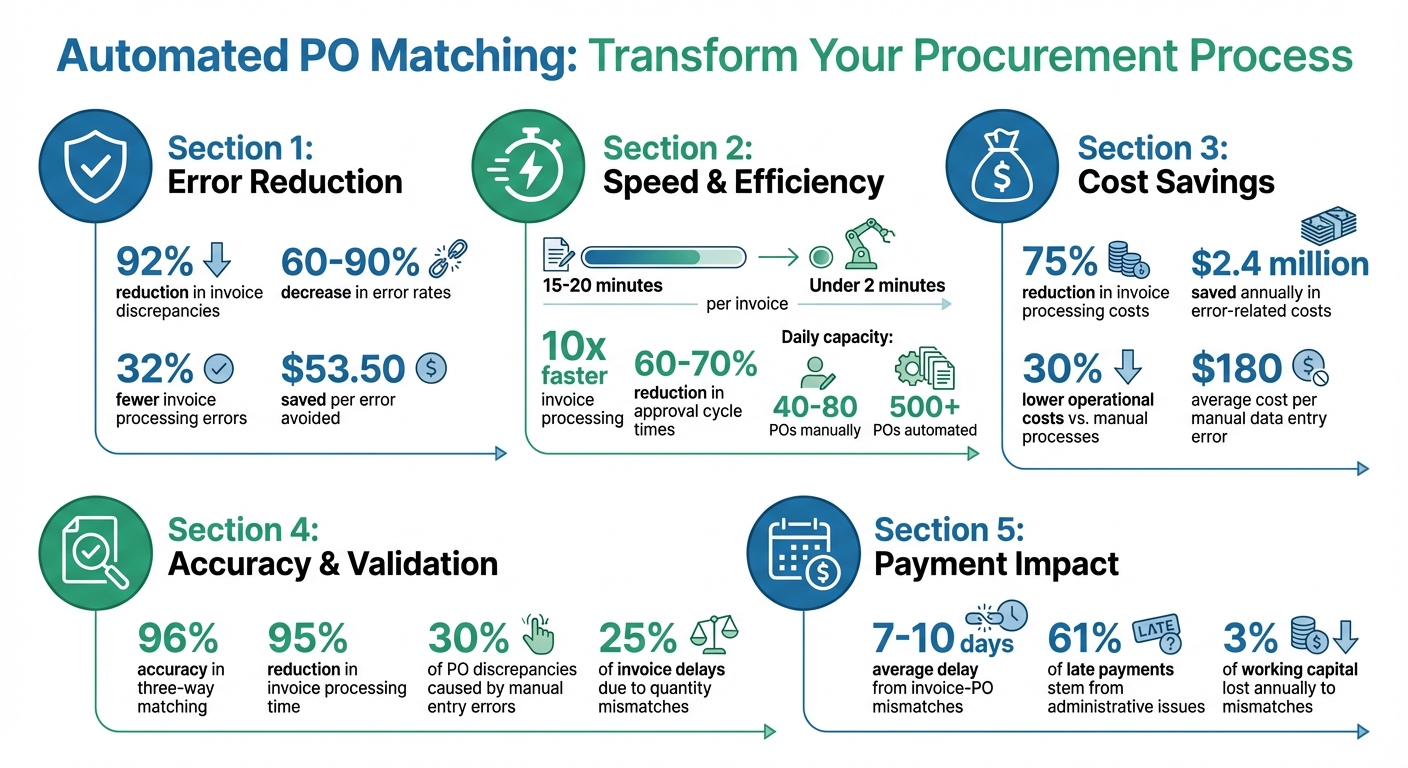
TL;DR: Automated purchase order (PO) matching drastically reduces errors, speeds up invoice processing, and saves costs. By replacing manual processes with AI-powered tools, businesses cut discrepancies by up to 92%, process invoices up to 10x faster, and save millions annually in error-related costs.
Manual PO matching is slow, error-prone, and expensive. It leads to payment delays, strained supplier relationships, and lost revenue due to mistakes and fraud. Automation solves these problems by using AI to handle tasks like three-way matching, data validation, and discrepancy resolution in real-time. For example, companies using automation tools report processing times dropping from 15–20 minutes to under 2 minutes per invoice, while error rates fall by 60–90%.
Key Benefits of Automated PO Matching:
- Fewer Errors: Reduces manual entry mistakes, pricing mismatches, and duplicate invoices.
- Cost Savings: Cuts invoice processing costs by up to 75%, saving $53.50 per error avoided.
- Faster Payments: Shortens approval cycles by 60–70%, improving supplier relationships.
- Fraud Prevention: Flags suspicious invoices and ensures secure, accurate payments.
- Efficiency Boost: Handles up to 500+ POs daily, compared to 40–80 manually.
AI-powered tools like Leverage AI integrate with ERP systems to streamline workflows, monitor supply chain performance, and ensure accurate data handling. By automating routine tasks, businesses can focus on strategic priorities while avoiding costly mistakes. Transitioning to automation is straightforward with proper ERP integration, team training, and continuous monitoring.
Automated PO Matching: Key Benefits and Cost Savings Statistics
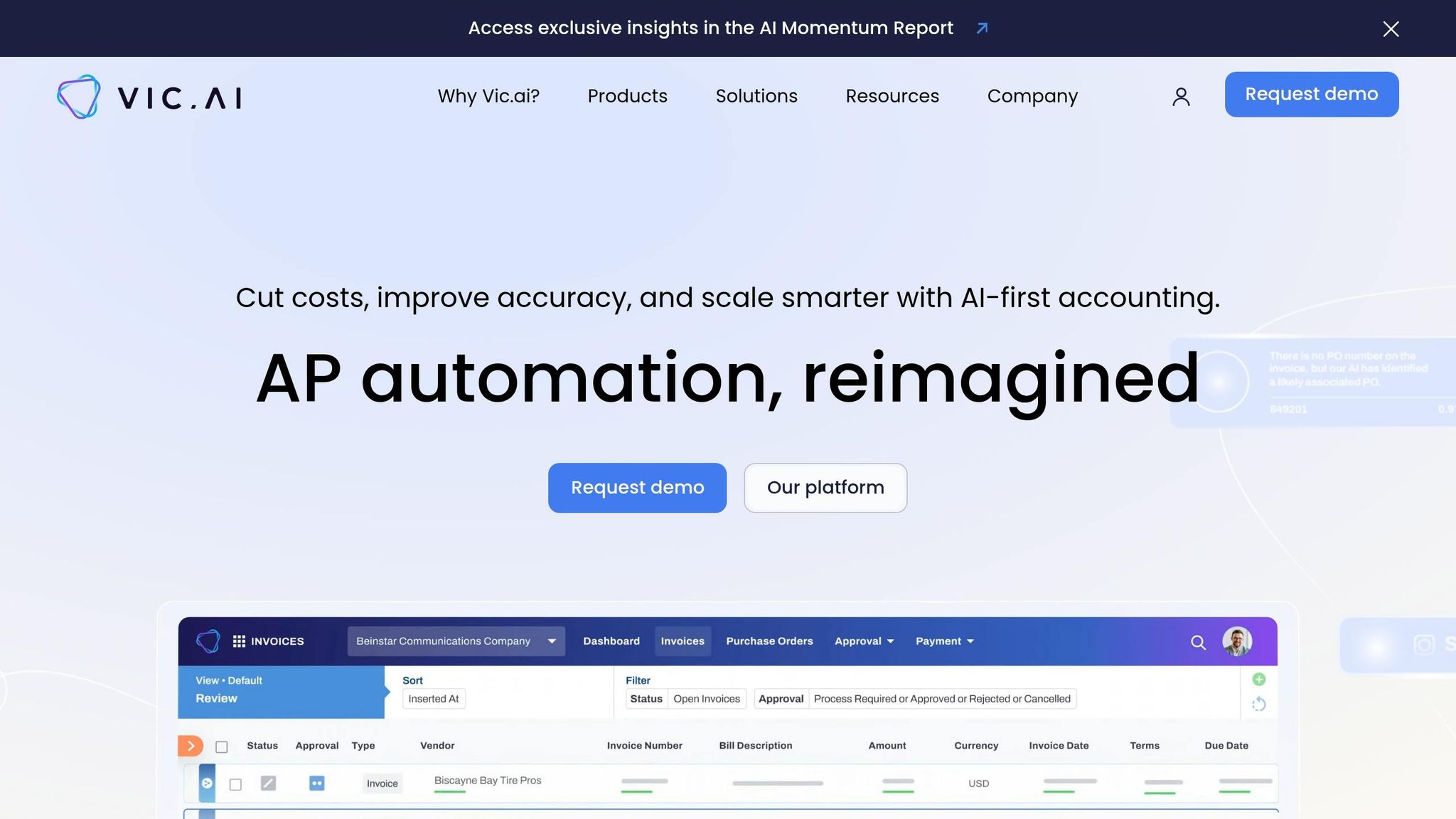
Autonomous Purchase Order (PO) Matching with Vic.ai
The Cost of Manual PO Matching Errors
The financial burden of manual purchase order (PO) matching is hard to ignore. Beyond just accounts payable, this process drains resources across the board. Every time your team manually compares purchase orders, invoices, and receiving reports, the costs add up fast. For instance, processing a single purchase order manually costs between $30 and $60, and invoice processing tacks on an additional $15 to $40 per transaction. Multiply these figures by hundreds of transactions each month, and the numbers become staggering - before even considering the expenses tied to inevitable errors. This makes it crucial to understand the common mistakes that occur during manual matching.
Typical Errors in Manual Processes
Manual PO matching is prone to human error, and these mistakes can snowball quickly. Data entry errors are a major culprit. A misplaced decimal, a swapped digit in a part number, or a typo in pricing details can trigger false exceptions, bringing the entire approval process to a standstill. In fact, manual entry is responsible for over 30% of PO discrepancies.
Other common issues include pricing and quantity mismatches. For example, quantity mismatches - such as billing for partial shipments, over-deliveries, or confusion over measurement units (e.g., boxes versus individual items) - are a leading cause of delays, accounting for 25% of all invoice processing delays.
Inconsistent vendor naming creates additional headaches. For instance, a vendor's invoice might list "Widget A", while your procurement system refers to the same item as "Model WA-2025." Someone must manually verify if they’re identical. Missing or incomplete data adds yet another layer of complexity. Emergency purchases that bypass procurement systems, partial deliveries without updated records, or invoices lacking corresponding POs all require time-consuming manual investigations.
Effects on Supply Chain Performance
The ripple effects of manual errors extend well beyond accounts payable, impacting the entire supply chain. Invoice-PO mismatches delay payment approvals by an average of 7 to 10 days. Worse, if an invoice is rejected due to a mismatch, the payment clock often resets entirely. For instance, a $10,000 order delayed by 60 days at a 9.5% interest rate results in $158 in interest charges. On a larger scale, these mismatches cost businesses around 3% of their working capital annually.
These delays strain supplier relationships in very real ways. 61% of late payments stem from administrative issues like incorrect invoices. Suppliers often respond by shortening credit terms, increasing prices, or, in extreme cases, halting shipments altogether. Manual tracking systems also extend processing times by 46%, adding about 11 hours of labor per purchase order. That’s valuable time that could be spent on more strategic activities, like negotiating with vendors or analyzing spending trends.
The broader impact is perhaps the most damaging. Manual processes trap essential data in disconnected systems, making it nearly impossible for finance teams to analyze spending patterns, pinpoint cost-saving opportunities, or monitor vendor performance effectively. Companies that rely on manual processes for order management end up spending 30% more on operational costs compared to those using automated systems. This creates a competitive disadvantage that affects not just accounts payable but the organization as a whole.
How Automated PO Matching Functions
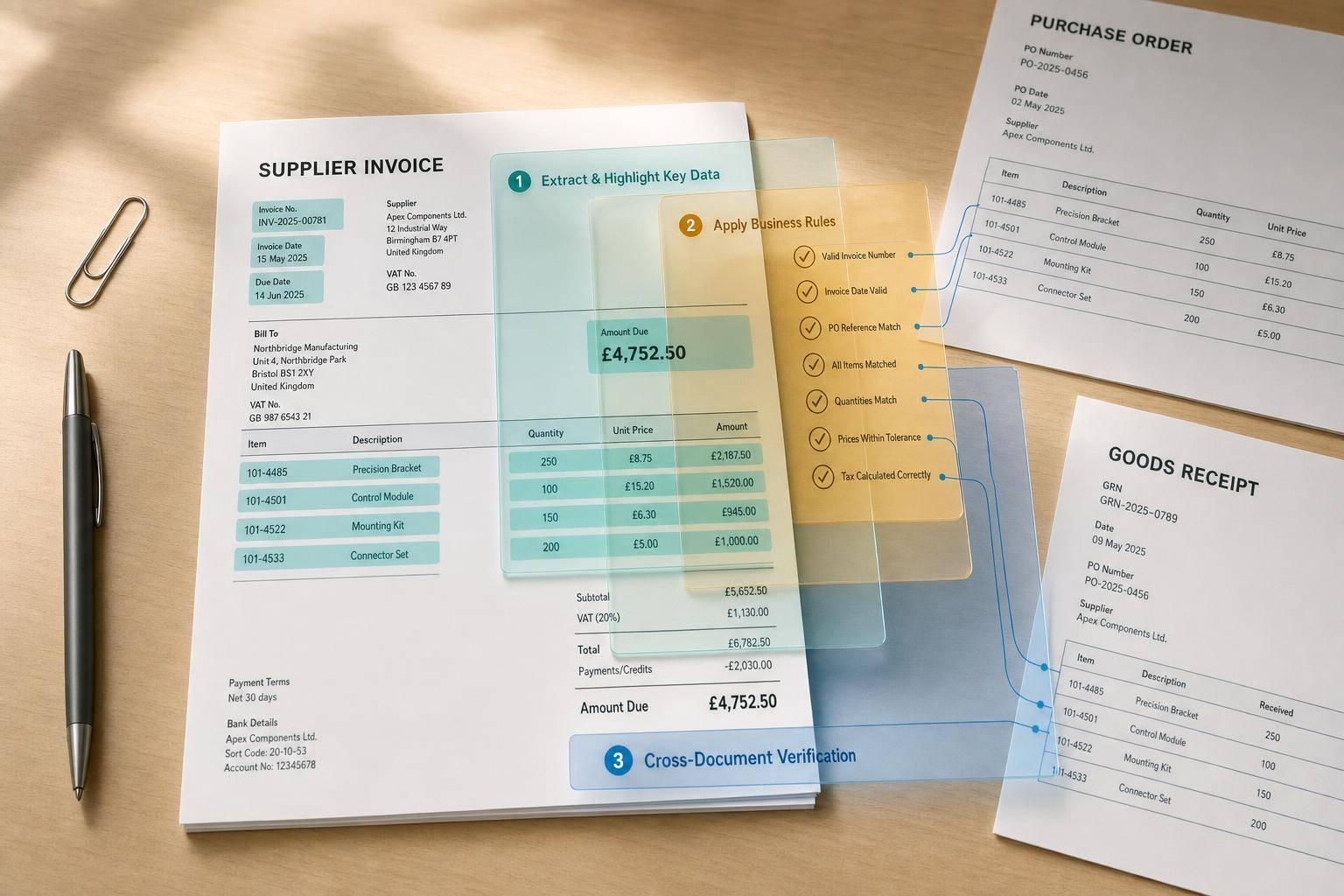
Automated PO matching takes the hassle out of manual document comparisons by using an AI-powered system to handle the process. At its core, this technology relies on Intelligent Document Processing (IDP) to manage the workload. It pulls documents from multiple sources - emails, PDFs, and even scanned images - and organizes them automatically. Then, Optical Character Recognition (OCR) converts these scans into machine-readable text, while Natural Language Processing (NLP) digs into the context, identifying key details like SKUs, prices, and quantities, even when the data is buried in unstructured formats.
What makes these systems stand out is their ability to deal with messy, inconsistent data. Unlike spreadsheets that demand exact matches, AI-powered fuzzy matching - boosted by Large Language Models (LLMs) - can interpret variations and unstructured product details. For example, in February 2026, Erewhon, a grocery chain, adopted Leverage AI’s fuzzy lookup technology to process 20,000 invoices per month across 10 stores. The system successfully matched abbreviations like "Santa Mon" or "SM" with "Santa Monica" in its master table. Once the data is extracted, the system performs a full three-way matching process.
AI and Technology in PO Matching
The real magic of automation lies in three-way matching, which cross-checks three critical data sources: the purchase order (what was ordered), the invoice (what’s owed), and the receiving report (what was delivered). This process happens in real-time, with the system verifying vendor IDs, item numbers, and contract pricing against ERP master data before posting. For instance, Mediaform, an Australian IT services company, implemented this workflow using Leverage AI in February 2026. In just one week, they built a system that now processes 200 purchase orders and 1,000 invoices monthly. It pulls live data from Microsoft Dynamics 365 Business Central via API to validate details like price, quantity, and addresses. Intelligent validation mechanisms further strengthen this process.
The system also uses confidence-gated workflows to ensure accuracy. Each data point is assigned a confidence score by the AI. If the score hits 95% or higher, the data posts automatically; anything lower is flagged for review. As one operations lead at a gas distribution company explained:
"The approval is all about the accurate extraction of the data. It has nothing to do with the content".
This method can slash per-invoice processing costs by nearly 75%. Once the data is validated, the system actively monitors and resolves discrepancies.
Automated Discrepancy Resolution
When the system detects a mismatch in quantity, price, or delivery date, it can auto-approve minor differences based on pre-set tolerance levels. For instance, a quantity variance within ±2% or a price difference within ±3% can be cleared automatically, avoiding unnecessary exception flags caused by rounding errors or unit conversions (like pounds versus kilograms). Larger discrepancies, however, prompt automated alerts to the appropriate stakeholders, following predefined service level agreements (SLAs).
Advanced systems also include supplier collaboration portals that notify vendors of discrepancies and let them propose resolutions, such as change orders. The system then checks these proposals against business rules, sends them to the buyer for approval, and updates the ERP with a complete audit trail. This "correct before commit" strategy tackles issues early, preventing payment delays or customer service problems. ACS Industries experienced this in early 2026 when they replaced their old system with Leverage AI. Managing over 400 purchase orders weekly, the AI-driven system handled matching across various formats without requiring vendor-specific customization.
Error Reductions Through Automation
Automating purchase order (PO) matching takes the guesswork out of manual entry and ensures consistent validation. Traditionally, manual PO processing comes with error rates ranging from 10% to 30%. However, organizations that adopt automation see a 60% drop in downstream invoice matching errors. This improvement doesn’t just make processes smoother; it directly impacts the bottom line. Fixing just one invoice error costs around $53.50, so reducing errors translates into tangible savings. With more accurate PO matching, businesses also benefit from stronger supply chain performance and better supplier relationships. These automated corrections tackle both cost and workflow inefficiencies, safeguarding financial accuracy.
Removing Data Entry Mistakes
By integrating directly with ERP systems, automation tools use technologies like OCR (Optical Character Recognition) and NLP (Natural Language Processing) to extract and validate data from PDFs, scans, and emails. This ensures that information matches master records, effectively preventing common issues like price mismatches, quantity discrepancies, or missing details.
But it doesn’t stop at eliminating human errors in data entry. These systems also provide an added layer of protection against duplicate and fraudulent transactions.
Stopping Duplicate and Fraudulent Transactions
Automated systems are designed to catch duplicate invoices by cross-checking PO IDs and line items across the entire database. This prevents double payments that might slip past manual reviewers. They also flag suspicious activity, such as fake invoices, unauthorized price changes, or inflated quantities. Fraud is no small issue - it costs businesses an average of 5% of their annual revenue every year.
To ensure payments are legitimate, the system validates Tax IDs and banking details, blocking any invoice that doesn’t have a pre-approved PO. Role-based access controls further enhance security by dividing responsibilities so no single individual has too much control over spending decisions. Every action is logged with a time-stamped, unchangeable audit trail, offering full transparency.
Faster Approval Workflows
Automation speeds up the approval process by handling high-confidence transactions automatically. When mismatches arise, the system flags the issue and routes it to the correct department or person. This approach yields measurable results - companies using automated workflows report 32% fewer invoice processing errors and a 60% to 70% reduction in approval cycle times.
This efficiency matters. Manual reconciliation eats up nearly 30% of a finance team’s operational time, and resolving a single document mismatch manually can cost anywhere from $15 to $50. With real-time ERP integration and instant alerts, exceptions are resolved quickly, ensuring payments stay on schedule. By automating routine tasks, accounts payable teams can focus their energy on true exceptions, making workflows far more efficient.
sbb-itb-b077dd9
Supply Chain Accuracy with Leverage AI
Leverage AI goes beyond simple automation, applying its capabilities to improve accuracy across the entire supply chain. By integrating seamlessly with leading ERP systems, it refines automated purchase order (PO) matching. With AI algorithms powering the process, the platform achieves an impressive 96% accuracy in detecting discrepancies during three-way matching. This level of precision enables manufacturers and distributors to identify inconsistencies before they escalate to accounts payable, effectively preventing overpayments and potential fraud. Companies that have adopted similar automation solutions report eliminating 92% of invoice discrepancies, resulting in savings of over $2.4 million annually in error-related costs. The following sections explore how automated supplier engagement, real-time tracking, and customizable workflows work together to reduce errors and streamline operations.
Purchase Order Automation and Supplier Engagement
Leverage AI automates the entire supplier communication process, sending POs directly via email and capturing accurate data right at the source. This automation reduces manual data entry errors, which can cost businesses an average of $180 per mistake. The system also handles follow-ups and reminders automatically, encouraging supplier responsiveness and helping to prevent delays, all while fostering stronger supplier relationships.
"Leverage saves each of our buyers at least 50% of their time every week, and we were able to reduce our planned headcount." - Steve Andrews, Director, Systems Control
Real-Time Supply Chain Visibility
Leverage AI provides real-time dashboards that track key metrics like PO status, supplier performance, and potential delays. By continuously syncing with ERP data, the platform ensures users have up-to-date insights, such as order fulfillment times, and automatically flags discrepancies. This approach slashes invoice processing time from 15–20 minutes to under 2 minutes per transaction, allowing teams to scale their workload tenfold without adding extra staff. Additionally, buyers receive instant notifications when suppliers propose changes to delivery dates, costs, or quantities. With a single click, they can approve or reject these updates, ensuring swift, accurate decision-making. This streamlined process not only reduces errors but also ensures smoother financial operations.
"We're now able to keep our customers happier because we can finally now answer their questions about where their stuff is." - Erin Purvis, Supply Chain, Blu Dot
Customizable Workflows and Error Reduction
Leverage AI further enhances accuracy with customizable workflows that automate routine approvals. Users can configure matching rules to fit their needs. For example, companies can set tolerance thresholds, such as allowing a ±3% price variance or a ±2% quantity difference, to auto-approve routine matches while routing exceptions to the appropriate team member. High-confidence AI extractions are posted directly to the ERP, while low-confidence cases are flagged for human review. This "correct before commit" approach identifies errors early, enabling a 95% reduction in invoice processing time and freeing finance teams to focus on strategic tasks instead of manual data entry.
| Match Category | Example Tolerance Rule | Action |
|---|---|---|
| Quantity | Within ±2% of PO up to 50 units | Auto-close/approve |
| Price | Within ±3% up to $1,000 variance | Auto-close or route to buyer |
| Date | Delivery ≤3 days early or late | No hold; auto-close |
| Freight/Fees | Within contracted caps | Auto-close or AP review |
These features create a comprehensive system that minimizes errors and boosts supply chain efficiency. By combining automation with intelligent workflows, Leverage AI helps businesses maintain accuracy and optimize performance.
Steps to Implement Automated PO Matching
Introducing automated PO matching can transform how organizations handle purchase orders, invoices, and receipts. By following a structured plan, companies have cut invoice processing times from 15–20 minutes to under 2 minutes while managing 10 times the workload - without hiring additional staff.
Integrating with ERP Systems
Start by connecting your automated PO matching tool to your ERP system, such as SAP or Oracle. Make sure your data structures align with the tool, and prioritize solutions offering native API integrations for seamless mapping of critical fields like PO numbers, quantities, and prices.
Begin with a pilot test on a smaller set of transactions to ensure three-way matching (PO, invoice, and receipt) works as expected. This step helps uncover data inconsistencies or system limitations early. If your ERP lacks native compatibility, use middleware and collaborate with your vendor to configure custom APIs.
For example, BTB Confections, a confectionery manufacturer, faced manual processes that caused three-week payment delays and an 8% error rate. By adopting automated PO matching, they processed invoices 95% faster and reduced matching errors by 92%. Once integration is successful, ensure your teams are ready to maximize the system’s capabilities.
Training Teams on AI Tools
Equip your accounts payable and procurement teams to handle exceptions and interpret AI-flagged discrepancies. Tailor training to specific roles - approvers can learn mobile approval workflows, while AP specialists focus on resolving tax and billing issues.
Use real-world scenarios in hands-on workshops, and consider certifying key users who can assist their peers. Quarterly refresher sessions are essential to keep skills sharp as the system evolves. The objective is to help staff understand that while AI automates routine matches, their expertise is needed for strategic tasks, not repetitive data entry.
| Exception Category | Typical Owner | Recommended SLA |
|---|---|---|
| Price/Terms | Buyer | 2 Business Days |
| Quantity/Receipt | Planner | 1 Business Day |
| Tax/Billing | AP Specialist | 2 Business Days |
| Master Data | Vendor Manager | 1 Business Day |
Monitoring and Continuous Improvement
Leverage real-time dashboards to track match accuracy, processing speed, and error rates. Tools like Leverage AI provide insights into PO status, patterns in discrepancies, and approval workflows, with alerts for exceptions requiring action.
Review analytics weekly to fine-tune tolerance thresholds and AI rules based on historical data. Conduct quarterly audits and gather supplier feedback to refine processes. For instance, if freight charges are frequently flagged as false positives, adjust variance rules to better reflect supplier practices. This ongoing refinement helps maintain a 92% error reduction and ensures your system evolves alongside your business needs.
Conclusion
Automated PO matching is a game-changer for streamlining procurement processes and cutting costs. By reducing discrepancies by 92% and slashing invoice processing times from 15–20 minutes to under 2 minutes, businesses can avoid overpayments averaging $180 per error. Companies using these systems report annual savings of over $2.4 million in error-related costs while managing 10 times the workload without increasing staff.
The transition from manual checks to AI-powered automation delivers noticeable improvements. Steve Andrews, Systems Control's Director, highlighted the operational and workforce planning benefits of these systems.
"Leverage is a total game-changer for us. I can't believe we managed our supply chain without this level of visibility before."
– Eric Swope, COO, Buckle Down
With real-time insights, seamless ERP integration, and 96% accuracy in matching POs, receipts, and invoices, these tools help businesses move from reactive problem-solving to proactive growth strategies. Platforms like Leverage AI not only automate purchase orders but also track supplier performance and offer customizable workflows, allowing manufacturers and distributors to focus on strengthening vendor relationships instead of resolving errors.
FAQs
What data is required for automated three-way matching?
Automated three-way matching revolves around three essential documents: the purchase order (PO), the invoice, and the goods receipt (or delivery confirmation). These documents are compared against each other to verify accuracy and consistency in transactions. By doing so, this process helps minimize errors and streamlines financial operations.
How do tolerance rules work for small price or quantity differences?
Tolerance rules define the acceptable range for small differences in price or quantity. When invoices fall within these predefined thresholds, they are automatically matched and processed for payment. This reduces the need for manual reviews while still maintaining proper financial oversight. The result? A smoother workflow that boosts efficiency without sacrificing control.
How long does ERP integration for PO matching usually take?
ERP integration for purchase order matching typically takes around 60 days to complete. This timeframe can be met by using efficient and low-risk approaches like middleware or low-code platforms, which help streamline the implementation process and reduce potential complications.