AI Workflow Sync: Procurement to Production

TL;DR: AI-powered platforms like Leverage AI, ORO Labs, Jinba AI, and Ivalua are transforming how procurement and production teams collaborate. By automating tasks, integrating with ERP systems, and providing real-time visibility, these tools reduce delays, improve efficiency, and save time. Each platform offers unique features - from supplier engagement to predictive maintenance - helping businesses streamline supply chain operations.
When procurement and production teams operate in silos, inefficiencies like manual follow-ups and delayed updates disrupt the supply chain. AI solutions bridge this gap by automating tasks such as order acknowledgments, shipment tracking, and supplier communication. Platforms like Leverage AI and ORO Labs integrate with ERP systems to provide real-time data, automate repetitive tasks, and reduce manual errors. For example, Leverage AI cuts buyer workload by 50%, while ORO Labs speeds up supplier onboarding by 75%. Jinba AI focuses on predictive maintenance and real-time monitoring, reducing equipment downtime by up to 50%. Meanwhile, Ivalua simplifies procure-to-pay processes, offering automation and centralized data for better decision-making. These tools empower teams to collaborate effectively, address delays proactively, and optimize supply chains.
Quick Comparison
| Platform | ERP Integration | Key Features | Primary Focus | Notable Results |
|---|---|---|---|---|
| Leverage AI | Direct integration with SAP, Oracle, etc. | Automated POs, supplier scorecards, real-time data | Procurement visibility | 50% time savings for buyers |
| ORO Labs | Unified ERP and data source integration | Smart PR creation, risk checks, supplier portal | Supplier operations | 75% faster supplier onboarding |
| Jinba AI | Works with legacy ERP systems | Predictive maintenance, IIoT integration | Production and equipment monitoring | 50% reduction in downtime |
| Ivalua | Multi-ERP environments supported | Procure-to-pay automation, supplier collaboration | Centralized procurement management | 90% first-time match rates on invoices |
Each platform addresses specific pain points, helping businesses reduce inefficiencies and improve supply chain performance.
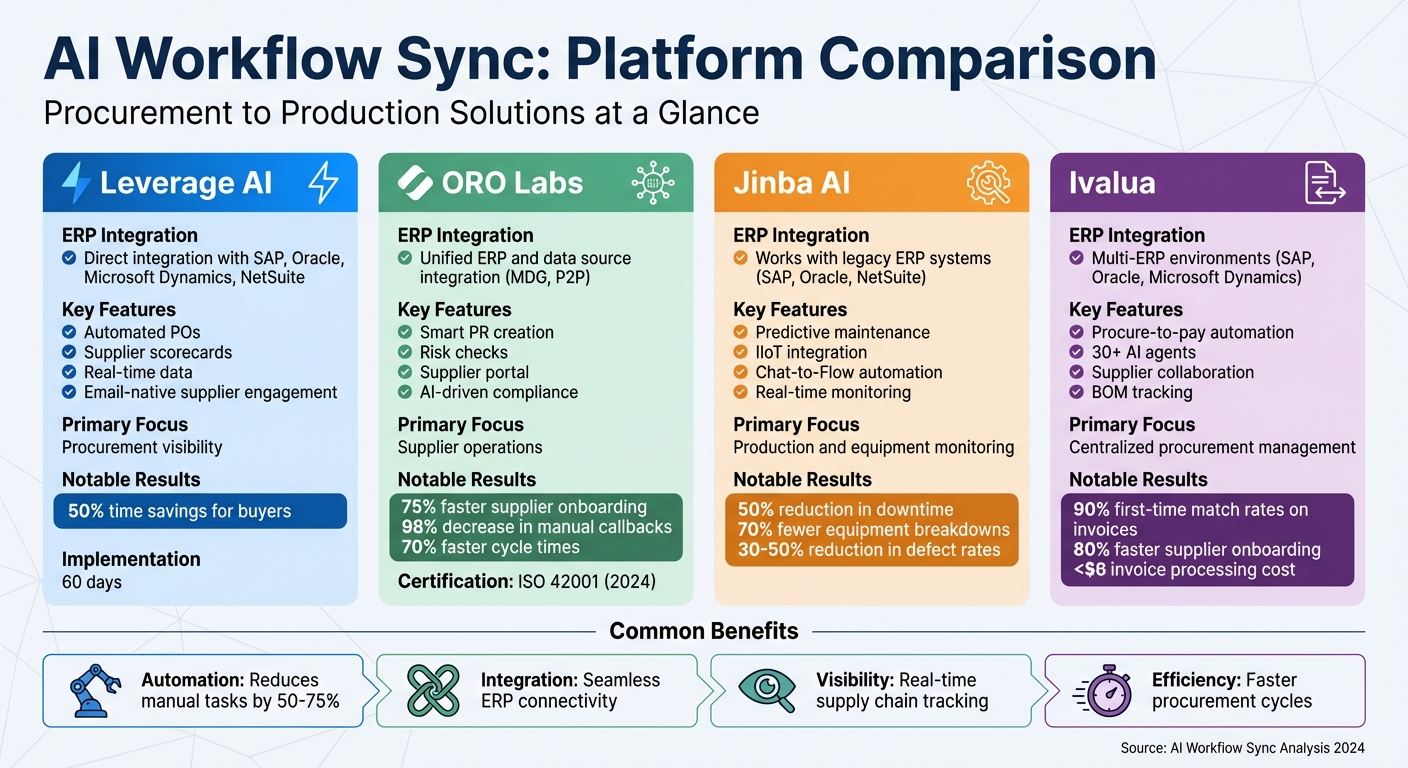
AI Procurement Platform Comparison: Features, Integration & Results
1. Leverage AI
ERP Integration
Leverage AI integrates directly with major ERP systems like SAP, Oracle, Microsoft Dynamics, and NetSuite, creating a centralized hub for procurement and production data. With pre-built integrations, the platform minimizes IT efforts, allowing the technical team to complete setups in just weeks or months - far quicker than the typical 9–24-month ERP replacement timeline. Once buyers approve changes through the dashboard, the ERP system updates automatically, eliminating the need for manual data entry. Beyond this smooth integration, Leverage AI takes over routine procurement tasks, saving time and effort.
Automation Features
Leverage AI employs AI agents to handle specific procurement activities. These agents can generate purchase orders from MRP demand plans, manage RFQ/RFP processes, and automatically request updated cost sheets from suppliers. The platform’s document parsing tool extracts key data from supplier acknowledgments or updates sent in PDF or Excel formats. A centralized dashboard highlights exceptions, such as changes in promise dates, costs, or quantities, enabling buyers to take quick action. Additionally, open order reports are automated, with scheduled updates sent to suppliers throughout the PO lifecycle. This level of automation feeds into real-time monitoring, significantly reducing manual intervention across the supply chain.
Real-Time Visibility
The platform continuously tracks supply chain activities, feeding acknowledgments, lead-time adjustments, and shipment notifications directly into the ERP system. It also provides supplier scorecards, which measure performance and pinpoint recurring inefficiencies. Eric Swope, COO at Buckle Down, shared his perspective:
"Leverage is a total game-changer for us. I can't believe we managed our supply chain without this level of visibility before".
This enhanced visibility allows teams to proactively address potential delays, keeping production schedules on track.
Supplier Engagement
Suppliers interact with "smart digital POs" directly through their email inboxes, eliminating the need for additional vendor portals. With connections to thousands of suppliers already in place, the platform is ready for immediate use without requiring extensive onboarding. Custom workflows ensure suppliers confirm orders and provide updates based on factors like supplier relationships, item importance, or PO priority. To further support procurement teams, a dedicated group of experts is available around the clock, every day of the year. This streamlined communication reduces delays and keeps procurement and suppliers aligned.
sbb-itb-b077dd9
2. ORO Labs
ERP Integration
ORO Labs serves as a bridge, linking ERP, P2P, and other data sources like quotes, statements of work, and emails into one cohesive system. Instead of replacing existing tools, it creates a unified hub for procurement operations. By consolidating supplier records from ERP systems, Master Data Governance (MDG), or file uploads, ORO builds a structured "golden record" that includes parent-child relationships. When suppliers update prices or contracts, ORO verifies and syncs this data with ERP records, contracts, PIRs, and source lists. Ana Pereira, IT Product Owner Procurement at Grünenthal, highlighted the benefits:
"The integration between ORO and our ERP system has been seamless, reducing manual effort and minimizing errors."
This streamlined integration led to a 75% reduction in supplier onboarding time and a 98% decrease in manual supplier callbacks. With this solid data foundation, ORO enables advanced automation capabilities.
Automation Features
ORO's AI-powered tools take on procurement tasks that usually require manual effort. For example, its "Smart PO/PR Creation" feature extracts details from proposals and contracts, mapping them directly into ERP systems. In managing direct materials, ORO identifies supplier price update types and verifies vendor and material information within the ERP. The "Agentic PR Review" automates compliance and risk checks during purchase requisition intake, speeding up cycle times by 70%. Companies using ORO have seen a 2.9x increase in touchless purchase orders, with 35% of transactions processed seamlessly. Additionally, ORO became the first procurement solution globally to achieve ISO 42001 certification for responsible AI management in 2024.
Real-Time Visibility
ORO Labs enhances procurement transparency by automating tasks and delivering real-time insights. Its "Universal Front Door" acts as a single portal for all procurement-related queries. With AI detecting user intent, requests are routed to the appropriate workflow, eliminating the need for manual translation of business needs into procurement actions. The platform also maintains comprehensive digital audit trails from intake to payment, centralizing access to contract terms, approvals, and risk assessments. This integration bridges the gap between procurement and production teams.
For suppliers, the "Supplier Front Door" provides a self-service tool to track invoices, orders, and onboarding progress in real time. In 2025, Bayer implemented ORO across its 93,000 employees and 88,000 suppliers, similar to how other pharma and biotechnology companies automate procurement. Employees could initiate complex purchases by simply uploading a quote, turning processes that once took days into tasks completed in minutes. This deployment achieved 20 days faster source-to-contract cycle times and improved process efficiency by 30% on average.
Supplier Engagement
The supplier portal in ORO Labs allows vendors to independently update banking and contact information and monitor request statuses without administrator involvement. This self-service feature minimizes friction between departments and simplifies communication with suppliers. By aggregating risk signals from multiple data sources, the platform assesses supplier and payment risks in real time, helping to prevent fraud and unauthorized spending. Timothy Harfield from ORO Labs emphasized:
"The use of AI allows us to more easily translate the needs of employees into business requirements and system tasks so they don't have to learn procurement in order to work with procurement."
User feedback has been overwhelmingly positive, with 93% reporting satisfaction with the platform. ORO also achieved a Net Promoter Score of 9+ from procurement teams. Furthermore, the system delivered 20%+ savings in supplier spend by improving orchestration and compliance monitoring.
3. Jinba AI
ERP Integration
Jinba AI addresses the challenges of outdated ERP systems by blending them with modern AI capabilities. It integrates seamlessly with legacy systems like SAP, Oracle, and NetSuite, enabling a two-way flow of data. This means it can pull real-time production data, such as inventory levels and machine sensor readings, while also pushing back updates like purchase orders and work orders into the ERP system. Considering that 70% of Fortune 500 companies still rely on systems that are over two decades old, Jinba offers a practical solution. Instead of replacing these costly systems, it wraps older databases - those without modern APIs - into usable endpoints.
The platform also simplifies automation with its Chat-to-Flow interface, which converts natural language instructions into automation drafts, reducing the need for complex coding. Security is a top priority, with features like SOC II compliance, role-based access control, and flexible hosting options, including on-premises or private cloud setups.
Automation Features
Jinba streamlines manual tasks that often slow down procurement and production processes. For instance, it monitors ERP stock levels in real time and automatically creates purchase orders when inventory dips below set thresholds, cutting supply chain disruptions by as much as 20%. Its dynamic approval routing adjusts workflows based on factors like purchase amount, department, or vendor risk. For example, orders exceeding $25,000 are automatically routed to the Finance team for approval. These automations help minimize delays across departments, ensuring smoother operations.
On the production side, Jinba connects to IIoT sensors to detect potential equipment issues. When fault patterns emerge, it automatically generates work orders in maintenance systems, allowing teams to address problems before equipment fails. Companies using predictive maintenance powered by AI have seen a 50% drop in downtime and up to 70% fewer equipment breakdowns. Additionally, its quality control systems assess defect severity using alerts from MES or SCADA systems, reducing defect rates by 30% to 50%. With its no-code platform, Jinba allows organizations to build and deploy solutions up to 90% faster than traditional methods.
Real-Time Visibility
By combining data from MES, ERP, and IIoT sensors, Jinba creates a unified view of operations. Leadership teams gain access to real-time metrics like OEE, scrap rates, and throughput, eliminating the delays caused by manual reporting, which can take up to a week. Automated quality alerts further enhance efficiency, cutting the time between defect detection and supervisor notification from over 45 minutes to under 5 minutes.
Jinba also maintains detailed audit trails, capturing timestamps, user actions, and approval decisions for all procurement and production activities. This capability shifts maintenance strategies from reactive to predictive, allowing teams to address potential equipment failures before they lead to costly shutdowns. This approach has been shown to reduce unplanned downtime by up to 30%. By delivering real-time data to both procurement and production teams, Jinba closes critical information gaps, paving the way for smoother supplier interactions.
Supplier Engagement
Jinba simplifies supplier engagement by automating onboarding processes, including data validation and document routing, to ensure consistency and compliance. It integrates with vendor databases to check budgets and update inventory records without requiring manual input. This level of automation speeds up communication with suppliers, reducing turnaround times by 25%.
4. Ivalua
ERP Integration
Ivalua integrates seamlessly with leading ERP systems like SAP, Oracle, and Microsoft Dynamics. This connection helps synchronize purchase orders, eliminate the hassle of duplicate data entry, and provides real-time insights into spending patterns. It’s designed to handle multi-ERP environments and supports direct materials management, including BOM tracking and forecast collaboration, ensuring materials are available when needed for production. This level of integration enables advanced automation across the procurement process.
Automation Features
Ivalua leverages "Agentic AI" with over 30 pre-built agents. These agents automate tasks like converting supplier PDF quotes into compliant purchase orders and performing AI-driven three-way matching. This results in over 90% first-time match rates and brings invoice processing costs down to less than $6. Smart rules are built into the system to enforce compliance, routing approvals based on factors such as purchase amount, department, or vendor risk. This allows procurement teams to complete the requisition-to-payment cycle in under five days. By bridging procurement and production teams, these features significantly reduce delays and streamline supply chain operations.
"We started our AI journey in 2023, currently we are running a very successful pilot with Ivalua IVA... what we hear most often right now is automation type use cases and analytics type use cases".
This progress was highlighted by Jan Van Hueth, Senior Project Manager at Körber.
Real-Time Visibility
Ivalua operates on a unified data model, serving as a central "source of truth" for both users and AI agents. This setup provides comprehensive visibility into suppliers, contracts, and inventory levels. Its Integration Hub ensures smooth data flow between AI agents, users, and systems. With this system, production teams can monitor supplier performance, track order statuses, and identify potential bottlenecks before they disrupt manufacturing schedules. Meanwhile, AI agents actively flag risks or opportunities for cost savings.
Supplier Engagement
Ivalua also transforms supplier relationships through its integrated and automated framework. Its no-cost supplier portal accelerates onboarding by 80% compared to older systems and ensures procurement strategies remain secure by avoiding pooled customer data. Companies like Whirlpool and Crédit Agricole have used this portal to onboard tens of thousands of suppliers efficiently. Automated tools for onboarding - such as data validation and document routing - support complex needs like BOM management and forecast collaboration, ensuring suppliers are aligned with production schedules.
"Ivalua's platform is designed for scalability… this level of futureproofing is unmatched. I can add new business lines, adapt to future market changes, and strategically find opportunities for savings and growth".
This sentiment was shared by Adam Lalani, Chief Technology Officer at Alliad.
AI becomes the pulse of procurement and supply chain
Strengths and Weaknesses
These platforms streamline procurement-to-production workflows by leveraging ERP integration, automation, real-time data access, and supplier collaboration. Below is a closer look at their standout features and areas where they could improve.
Leverage AI is known for its quick implementation and seamless supplier engagement through email. It integrates directly with ERP systems and uses AI-based document parsing to provide predictive ETAs. Steve Andrews, Director at Systems Control, shared:
"Leverage saves each of our buyers at least 50% of their time every week, and we were able to reduce our planned headcount".
While it excels in purchase order visibility and exception management, its focus in these areas may limit its ability to deliver broader spend analytics.
ORO Labs brings AI-native workflows to the table, emphasizing data validation and risk reduction across supplier operations. It provides comprehensive visibility into procurement processes. Its strengths lie in smart procurement automation, though there is limited documentation about its supplier communication tools.
Jinba AI is another player in the market, but publicly available information about its automation capabilities, real-time data features, and supplier engagement tools is scarce, making it harder to evaluate its overall potential.
Ivalua offers procure-to-pay automation with ERP integration, enabling features like real-time data sharing, automated purchase order generation, and three-way matching through a supplier portal. Its unified data model acts as a central source of truth. However, its high level of customization can result in longer implementation timelines.
Recognizing these strengths and limitations is essential for improving workflow synchronization across departments in AI-driven supply chains.
Conclusion
Leverage AI offers a tailored solution for mid-to-large manufacturers needing quick implementation - often within 60 days - without requiring suppliers to adopt new systems or portals. Its email-native design maintains existing supplier relationships and connects seamlessly to thousands of suppliers, avoiding the usual onboarding hurdles that can slow down adoption.
In addition to these benefits, Leverage AI provides ongoing support through its managed service. With Leverage Pros available 24/7/365, you gain access to a team of supply chain experts who handle exceptions, address quality issues, and provide proactive management. This approach combines advanced automation with human expertise, complementing rather than replacing professional judgment.
By automating tasks like supplier follow-ups and eliminating manual data entry, Leverage AI directly addresses inefficiencies in the supply chain. Erin Purvis from Blu Dot’s supply chain team highlighted the platform’s impact:
"We're now able to keep our customers happier because we can finally now answer their questions about where their stuff is".
To make the most of Leverage AI, start by mapping out your current purchase order lifecycle to identify manual pain points, such as email-based approvals or limited line-level visibility. A pilot program focusing on high-volume, low-risk suppliers can help assess the accuracy of AI-driven data extraction before scaling up. Additionally, ensure the platform you choose provides features like immutable audit logs and role-based access to meet compliance requirements.
Leverage AI strikes a balance between speed, supplier collaboration, and automation. Its ERP-embedded design delivers real-time updates directly within your system of record, while automated supplier scorecards enable procurement teams to track vendor performance over time. This blend of better visibility, streamlined processes, and expert support helps align procurement and production seamlessly.
FAQs
How does AI sync procurement and production data in real time?
AI connects procurement and production data instantly by working with ERP systems to automate tasks such as tracking orders and managing supplier communications. By leveraging predictive analytics and IoT devices, it keeps tabs on shipments, inventory levels, and external factors, ensuring all systems stay updated. This approach helps speed up decision-making, minimizes delays, and boosts workflow efficiency overall.
What ERP setup is needed to automate supplier follow-ups and PO updates?
To streamline supplier follow-ups and purchase order (PO) updates, your ERP system requires an automation layer. This layer should be capable of processing supplier and carrier emails, aligning the data with PO master records, and sending structured updates directly back to the ERP. With this setup, you can achieve real-time visibility and handle exceptions more efficiently.
How do you pilot AI automation without disrupting suppliers or production?
To ensure a smooth pilot phase for AI automation, adopt a real-time workflow approach. This helps identify discrepancies early and allows for automated follow-ups with suppliers. By standardizing purchase order processes and using AI to address mismatches, you can streamline operations and reduce errors.
Additionally, automating supplier communications and integrating AI with ERP systems can make exception management more proactive. This approach minimizes manual effort, prevents delays, and helps maintain strong supplier relationships throughout the pilot phase.