---
title: "Procurement Automation for Industrial Distributors: The 2026 Guide"
description: How mid-market industrial distributors automate PO follow-ups, supplier acknowledgments, and exception handling across hundreds of SKUs without replacing their ERP.
image: https://tryleverage.ai/hubfs/blog-covers/cover-procurement-automation-industrial-distributors-guide.png
---
[Skip to main content](https://tryleverage.ai/blog/pf/procurement-automation-industrial-distributors-guide#main-content)
[   ](https://tryleverage.ai)
- Show submenu for Platform Platform
- [CONNECT: Integrations](https://tryleverage.ai/integrations)
- [PARSE: Document Parsing](https://tryleverage.ai/document-parsing)
- [MEASURE: Supplier Performance](https://tryleverage.ai/supplier-performance)
- [PAY: Trade Finance](https://tryleverage.ai/payments)
- [ENGAGE: PO Automation](https://tryleverage.ai/purchase-order-automation)
- [TRACK: Shipments](https://tryleverage.ai/shipment-tracking)
- [COPILOT: AI Agents](https://tryleverage.ai/artificial-intelligence)
- Show submenu for Case Studies Case Studies
- [Manufacturing](https://tryleverage.ai/case-study-manufacturing)
- [Distribution](https://tryleverage.ai/case-study-distribution)
- [Pharma & Biotechnology](https://tryleverage.ai/case-study-pharma-biotechnology)
- [Food Production](https://tryleverage.ai/case-study-food-production)
- [Furniture](https://tryleverage.ai/case-study-furniture)
- [Supplements](https://tryleverage.ai/case-study-supplements-manufacturing)
- [Packaging](https://tryleverage.ai/case-study-packaging-manufacturing)
- [Automotive Parts Distributor](https://tryleverage.ai/case-study-auto-parts-distributor)
- [Commercial Equipment](https://tryleverage.ai/case-study-commercial-equipment)
- [Wood Processing Equipment](https://tryleverage.ai/case-study-wood-processing-equipment)
- Show submenu for Company Company
- [Our Story](https://tryleverage.ai/our-story)
- [Podcast](https://tryleverage.ai/podcast)
- [Blog](https://tryleverage.ai/blog)
- [Careers](https://tryleverage.ai/careers)
- [Partners](https://tryleverage.ai/partners)
- [Contact Us](https://tryleverage.ai/contact)
Open main navigation
Close main navigation
- Show submenu for Platform Platform
- Platform
- [CONNECT: Integrations](https://tryleverage.ai/integrations)
- [PARSE: Document Parsing](https://tryleverage.ai/document-parsing)
- [MEASURE: Supplier Performance](https://tryleverage.ai/supplier-performance)
- [PAY: Trade Finance](https://tryleverage.ai/payments)
- [ENGAGE: PO Automation](https://tryleverage.ai/purchase-order-automation)
- [TRACK: Shipments](https://tryleverage.ai/shipment-tracking)
- [COPILOT: AI Agents](https://tryleverage.ai/artificial-intelligence)
- Show submenu for Case Studies Case Studies
- Case Studies
- [Manufacturing](https://tryleverage.ai/case-study-manufacturing)
- [Distribution](https://tryleverage.ai/case-study-distribution)
- [Pharma & Biotechnology](https://tryleverage.ai/case-study-pharma-biotechnology)
- [Food Production](https://tryleverage.ai/case-study-food-production)
- [Furniture](https://tryleverage.ai/case-study-furniture)
- [Supplements](https://tryleverage.ai/case-study-supplements-manufacturing)
- [Packaging](https://tryleverage.ai/case-study-packaging-manufacturing)
- [Automotive Parts Distributor](https://tryleverage.ai/case-study-auto-parts-distributor)
- [Commercial Equipment](https://tryleverage.ai/case-study-commercial-equipment)
- [Wood Processing Equipment](https://tryleverage.ai/case-study-wood-processing-equipment)
- Show submenu for Company Company
- Company
- [Our Story](https://tryleverage.ai/our-story)
- [Podcast](https://tryleverage.ai/podcast)
- [Blog](https://tryleverage.ai/blog)
- [Careers](https://tryleverage.ai/careers)
- [Partners](https://tryleverage.ai/partners)
- [Contact Us](https://tryleverage.ai/contact)
- [Login](https://app.lvrg.ai/signin)
[See Demo](https://tryleverage.ai/request-a-demo)
[Login](https://app.lvrg.ai/signin)
[See Demo](https://tryleverage.ai/request-a-demo)
# Procurement Automation for Industrial Distributors: The 2026 Guide

By [Nadav Ullman](https://tryleverage.ai/blog/author/nadav-ullman) · Aug 19, 2026, 8:06:14 AM
🎧 Listen to this article (23 min)
Your browser does not support the audio element.
Procurement automation for industrial distributors uses software and AI to execute purchasing tasks, PO creation, supplier follow-ups, acknowledgment tracking, and invoice matching, without manual intervention. For mid-market distributors managing hundreds of SKUs across 150+ suppliers, these tools eliminate the repetitive work that overwhelms procurement teams and creates costly errors. The right industrial automation solutions are purpose-built for distribution workflows, not retrofitted from manufacturing systems, which means they address the specific pressures of high SKU counts, multi-supplier coordination, and fast-moving inventory cycles that define your operation.
If your procurement team spends more time chasing PO confirmations than negotiating better terms or optimizing supplier relationships, you're experiencing exactly the bottleneck that workflow automation is designed to solve. This guide covers what procurement automation means for distributors specifically, how it differs from manufacturer-focused tools, which platforms serve the mid-market distribution space, and how to implement process automation without ripping out your existing ERP.
## What Is Procurement Automation and Why Distributors Need It
Procurement automation streamlines manual tasks across the procure-to-pay process, reducing cycle times, improving accuracy, and enabling procurement teams to focus on strategic work instead of administrative follow-ups. For industrial distributors, this means automating PO delivery, supplier acknowledgment collection, status updates, and exception handling, the exact tasks that consume disproportionate time when managed through spreadsheets and email threads.
The core value proposition is straightforward: when you automate the repetitive coordination work, supplier collaboration improves and operations move faster. A procurement manager handling 400+ SKUs from 150 suppliers cannot manually track every PO acknowledgment, chase every late confirmation, and reconcile every invoice discrepancy without either burning out or letting errors slip through.
Industrial automation software designed for distributors typically handles several interconnected functions. PO generation and transmission happen automatically based on reorder points or demand signals. Supplier acknowledgments are captured and matched to original orders without manual data entry. Status updates flow back into your system in real time, eliminating the "where's my order?" calls that consume hours each week.
The distinction between automation and digitization matters here. Simply moving from paper to email isn't automation, it's just faster paper. True process automation means the system takes action based on rules and conditions without requiring a human to initiate each step. When a supplier fails to acknowledge a PO within 24 hours, the system sends a follow-up. When an acknowledgment shows a different ship date than requested, the system flags the exception for review.
For distributors specifically, the need is acute because margins are tight and operational efficiency directly impacts profitability. Unlike manufacturers who may have longer lead times and fewer supplier relationships, distributors operate as coordination hubs where speed and accuracy determine customer satisfaction. If you want to end manual PO follow-ups, automation isn't optional, it's the only way to scale without proportionally scaling headcount.
## Key Challenges Distributors Face vs. Manufacturers
Distributors face fundamentally different procurement pressures than manufacturers, yet most enterprise procurement tools are architected for manufacturing workflows. Understanding this mismatch explains why generic industrial automation solutions often create friction rather than efficiency for distribution operations.
The first major difference is supplier volume and diversity. A manufacturer might work with 20-50 suppliers for raw materials and components, developing deep integrations with each. A mid-market industrial distributor typically manages 100-200+ supplier relationships, many with electronic component distributors, industrial equipment vendors, and specialty suppliers who have varying levels of digital maturity. Building custom EDI connections with every supplier isn't feasible when half of them still confirm orders via email or phone.
SKU complexity compounds this challenge. Manufacturers deal with bills of materials, structured, predictable component relationships. Distributors manage broad catalogs where any SKU might come from multiple suppliers, pricing changes frequently, and substitution decisions happen in real time. Your procurement system needs to handle this variability without requiring constant manual intervention.
Order velocity creates another distinction. Manufacturing procurement often operates on longer planning horizons with scheduled production runs. Distribution procurement responds to customer demand that can shift daily. When a customer needs industrial automation supply items shipped tomorrow, your procurement team can't wait three days for a supplier acknowledgment, they need real-time visibility into order status.
The EDI barrier deserves specific attention because it stops many distributors from pursuing automation. Traditional B2B integration assumes both parties have EDI infrastructure, but regional distributors frequently work with suppliers who lack this capability. The misconception that automation requires full EDI adoption prevents many mid-market distributors from exploring solutions. In reality, modern platforms offer EDI alternatives for PO automation that work with suppliers regardless of their technical sophistication.
Finally, ERP limitations create friction. Many distributors run older ERP systems that weren't designed for the API-first integrations that modern automation requires. The prospect of a full ERP overhaul, with its cost, disruption, and risk, makes automation seem inaccessible. This is why procurement automation without EDI has become a critical capability for platforms serving the distribution market.
## Top Procurement Automation Platforms for Industrial Distributors
The procurement automation landscape includes both enterprise platforms designed for large organizations and purpose-built solutions targeting mid-market distributors. Choosing the right platform depends on your supplier ecosystem, ERP environment, and specific workflow pain points.
Platforms serving industrial distributors generally fall into three categories: full-suite procurement systems, point solutions for specific workflows, and AI-powered coordination tools that sit between your ERP and suppliers.
Full-suite procurement systems like those from major enterprise vendors offer comprehensive functionality but often require significant implementation investment and assume EDI-ready supplier networks. These work well for larger distributors with IT resources and suppliers who can support structured integrations. The tradeoff is complexity, you're buying capabilities you may not need while potentially missing distributor-specific features.
Point solutions address specific pain points like AP automation or invoice processing. These tools excel at their narrow function but create integration challenges when you need workflows to connect. If your primary issue is invoice matching and payment processing, an AP automation tool might solve that problem. But if your bottleneck is PO follow-ups and supplier communication, you need a different solution.
AI-powered coordination platforms represent the emerging category most relevant to mid-market distributors. These tools use artificial intelligence to handle supplier communication, track PO status, manage acknowledgments, and flag exceptions, without requiring suppliers to adopt new technology. They work with email, portals, and EDI depending on what each supplier supports.
For a detailed comparison of specific tools serving this market, the 7 automation tools for mid-market distributors in 2026 guide provides platform-by-platform analysis with feature comparisons and use case recommendations.
When evaluating platforms, prioritize these capabilities for distribution-specific workflows:
- Multi-channel supplier communication that works with EDI, email, and portal-based suppliers
- Acknowledgment capture and matching that handles varied supplier response formats
- Exception management that surfaces problems before they become customer-facing issues
- ERP integration that works with your existing system rather than requiring replacement
- Scalability that handles your current supplier count with room for growth
The right platform should reduce your team's manual workload within weeks, not months. If implementation requires a year-long project before you see value, the solution isn't designed for mid-market distribution realities.
## ROI Benchmarks and Efficiency Gains for Mid-Market Distributors
According to Gartner, 50% of purchase order lines undergo changes after issuance, making real-time supplier visibility a procurement priority.
Aberdeen Group research shows that automated PO tracking reduces operational costs by up to 30% for mid-market manufacturers.
A Deloitte supply chain study found that 70% of supply chain disruptions originate before materials leave the supplier's facility.
Procurement automation delivers measurable returns across several operational dimensions, and understanding these benchmarks helps build the business case for investment. For mid-market distributors, the ROI calculation centers on time savings, error reduction, and the strategic value of freeing procurement staff for higher-impact work.
Time savings represent the most immediate and quantifiable benefit. Manual PO follow-ups, calling suppliers, sending reminder emails, logging responses, updating systems, consume hours daily for procurement teams managing large supplier networks. Automating this workflow typically reduces procurement administrative time significantly, with some distributors reporting 50% reductions in time spent on routine coordination tasks.
Error reduction compounds these savings. Manual data entry between systems creates transcription errors. Missed acknowledgments lead to surprise delays. Untracked changes to ship dates or quantities cause inventory planning failures. Each error requires time to identify, investigate, and resolve, time that disappears when automation handles the data flow.
The strategic value is harder to quantify but often more important. When your procurement team stops spending their days on follow-up calls, they can focus on supplier negotiations, alternative sourcing, and demand planning. These activities directly impact margins in ways that administrative work never can.
For executives building a business case, the PO tracking automation RFP and ROI guide provides frameworks for calculating expected returns based on your specific operational metrics.
Key performance indicators worth tracking before and after implementation include:
- Average time from PO creation to supplier acknowledgment
- Percentage of POs requiring manual follow-up
- Order accuracy rate (matching what was ordered to what was shipped)
- Procurement team hours spent on administrative vs. strategic tasks
- Supplier on-time delivery performance
- Exception resolution time
The connection between data visibility and procurement decisions extends beyond efficiency metrics. When you have real-time visibility into supplier performance, acknowledgment patterns, and delivery reliability, you can make better sourcing decisions. This data-driven approach to procurement transforms automation from a cost-reduction tool into a competitive advantage.
Implementation costs vary significantly based on platform choice and integration complexity. Cloud-based solutions designed for mid-market distributors typically offer subscription pricing that scales with transaction volume, avoiding the large upfront investments that enterprise platforms require. The payback period for most mid-market implementations ranges from months to a year, depending on current manual workload and supplier volume.
## How to Implement Workflow Automation Without Overhauling Your ERP
Whether your procurement team runs on SAP, Oracle NetSuite, Microsoft Dynamics 365, Epicor, or Infor, the automation layer should sit on top of the ERP you already own rather than replace it.
For teams running Microsoft Dynamics 365, whether Business Central, Finance and Supply Chain, or Navision, Leverage AI integrates directly with your existing ERP environment to automate supplier PO confirmations, flag exceptions in real time, and surface OTIF data without custom development or ERP modification.
Implementing procurement automation doesn't require replacing your ERP system, despite what some enterprise vendors suggest. Modern workflow automation tools are designed to work alongside existing systems, extracting data, coordinating with suppliers, and pushing updates back without requiring deep technical integration.
The key architectural principle is treating automation as a coordination layer rather than a replacement system. Your ERP remains the system of record for inventory, orders, and financials. The automation platform handles the supplier-facing communication and status tracking that your ERP wasn't designed to manage.
Start by mapping your current procurement workflow from requisition through receipt. Identify the manual touchpoints, where does someone have to send an email, make a call, or copy data between systems? These touchpoints are your automation targets. Prioritize based on time consumption and error frequency.
For most distributors, PO acknowledgment and status tracking represent the highest-impact starting point. This workflow is repetitive, time-consuming, and error-prone when handled manually. It also doesn't require changing how you create POs or manage inventory, you're automating the communication layer, not the core transaction processing.
Supplier onboarding is often simpler than expected. Modern platforms can work with suppliers via email, extracting acknowledgment information from their responses without requiring them to log into a portal or implement EDI. This approach removes the supplier adoption barrier that stalls many automation initiatives.
The supplier communication automation guide details how to automate PO status updates without requiring suppliers to use a portal, addressing one of the most common implementation concerns for distributors with diverse supplier networks.
Integration with your ERP typically happens through one of three methods: API connections for modern cloud-based ERPs, file-based data exchange for older systems, or manual export/import for initial pilots. The right approach depends on your technical resources and how quickly you need to move.
A phased implementation reduces risk and builds organizational confidence. Start with a subset of suppliers, perhaps your highest-volume or most problematic relationships, and expand as you validate the workflow. This approach lets you refine processes before scaling and demonstrates value to stakeholders who may be skeptical of automation claims.
Change management matters as much as technology. Your procurement team needs to understand what the automation handles and what still requires their attention. Clear exception handling processes ensure that automated workflows don't create blind spots. Training should focus on the new role, managing exceptions and focusing on strategic work, rather than just the software mechanics.
## Get Started with tryleverage.ai
tryleverage.ai provides AI-powered procurement automation specifically designed for mid-market industrial distributors managing complex supplier networks. The platform handles PO delivery, acknowledgment capture, status tracking, and exception management without requiring suppliers to adopt new technology or distributors to replace their ERP systems.
For distributors dealing with the exact scenario described at the start of this guide, 400+ SKUs, 150 suppliers, overwhelmed procurement teams, tryleverage.ai addresses the core pain points directly. The platform works with suppliers regardless of their technical sophistication, using AI to extract information from email responses, portal notifications, and EDI transactions.
The implementation approach prioritizes speed to value. Rather than a months-long integration project, most distributors begin seeing results within weeks. The platform connects to your existing systems and starts automating supplier communication immediately, with refinements happening as you scale.
To see how this works in practice, the distribution industry case study shows real results from distributors who have implemented the platform. These examples demonstrate the efficiency gains and ROI benchmarks discussed earlier in concrete, operational terms.
If your procurement team is spending more time on follow-ups than on strategic sourcing, automation isn't a future consideration, it's an immediate operational need. The tools exist, the implementation paths are proven, and the ROI is measurable. The question is whether you continue absorbing the cost of manual processes or invest in the industrial automation solutions that let your team focus on work that actually moves the business forward.
## Related Reading
- [Dynamics 365 procurement automation](https://tryleverage.ai/blog/pf/dynamics-365-procurement-automation-po-visibility)
- [ERP-agnostic PO automation](https://tryleverage.ai/blog/pf/erp-agnostic-po-automation-vs-built-in-erp-modules)
- [PO automation ROI model](https://tryleverage.ai/blog/pf/po-tracking-automation-roi-model)
- [PO exception management checklist](https://tryleverage.ai/blog/pf/po-exception-management-checklist)
- [supplier OTIF tracking](https://tryleverage.ai/blog/pf/supplier-otif-tracking-erp-incomplete-data-1)
- [Leverage AI platform](https://tryleverage.ai/product)
## Frequently Asked Questions
What is procurement automation for industrial distributors?
Procurement automation for industrial distributors is the use of software and AI to execute purchasing tasks, PO creation, supplier follow-ups, acknowledgment tracking, and invoice processing, without manual intervention. Unlike generic procurement tools built for manufacturers, distributor-focused automation addresses high SKU counts, multi-supplier coordination, and the varied digital maturity of supplier networks. The goal is eliminating repetitive administrative work so procurement teams can focus on strategic sourcing and supplier relationship management.
### How can industrial distributors automate the procurement process?
Industrial distributors automate procurement by implementing platforms that handle supplier communication, PO tracking, and exception management automatically. The process typically starts with automating PO delivery and acknowledgment capture, then expands to status tracking and invoice matching. Modern platforms work with suppliers via email, portals, or EDI depending on each supplier's capabilities, removing the requirement that all suppliers adopt new technology before automation can begin.
### Which procurement tasks can be automated at a distribution company?
Distribution companies can automate PO generation and transmission, supplier acknowledgment collection, order status tracking, follow-up communications for unconfirmed orders, exception flagging for date or quantity changes, invoice matching, and payment processing. The highest-impact tasks for most distributors are acknowledgment tracking and follow-up automation, which consume disproportionate time when handled manually across large supplier networks.
### Can procurement automation work without EDI-enabled suppliers?
Yes, procurement automation works without EDI-enabled suppliers. Modern platforms use AI to extract information from email responses, parse varied document formats, and communicate with suppliers through whatever channel they prefer. This capability is essential for mid-market distributors who work with suppliers ranging from large EDI-capable vendors to small specialty suppliers who confirm orders via email or phone.
### What ERP systems does procurement automation software integrate with?
Procurement automation software integrates with major ERP systems through APIs, file-based data exchange, or hybrid approaches depending on the ERP's technical architecture. Common integrations include cloud-based ERPs like NetSuite and Acumatica, as well as older on-premise systems. The integration approach varies by platform, some require deep technical connections while others work as a coordination layer that exchanges data with your ERP without requiring extensive customization.
### What KPIs should industrial distributors track to measure procurement automation ROI?
Industrial distributors should track average time from PO creation to supplier acknowledgment, percentage of POs requiring manual follow-up, order accuracy rates, procurement team hours spent on administrative versus strategic tasks, supplier on-time delivery performance, and exception resolution time. Comparing these metrics before and after implementation provides clear ROI evidence and identifies areas for further optimization.
How do you choose the right procurement automation platform for an industrial distribution company?
Choose a procurement automation platform by evaluating multi-channel supplier communication capabilities, acknowledgment capture flexibility, exception management features, ERP integration requirements, and scalability for your supplier volume. Prioritize platforms designed for distribution workflows rather than manufacturing, and look for implementation timelines measured in weeks rather than months. Request demonstrations using your actual supplier scenarios to verify the platform handles your specific workflow complexity.

About Nadav Ullman
Entrepreneur, Investor | Forbes 30 Under 30
[Website](https://tryleverage.ai)[LinkedIn](https://www.linkedin.com/in/nadavism/)
## Related Articles
##### [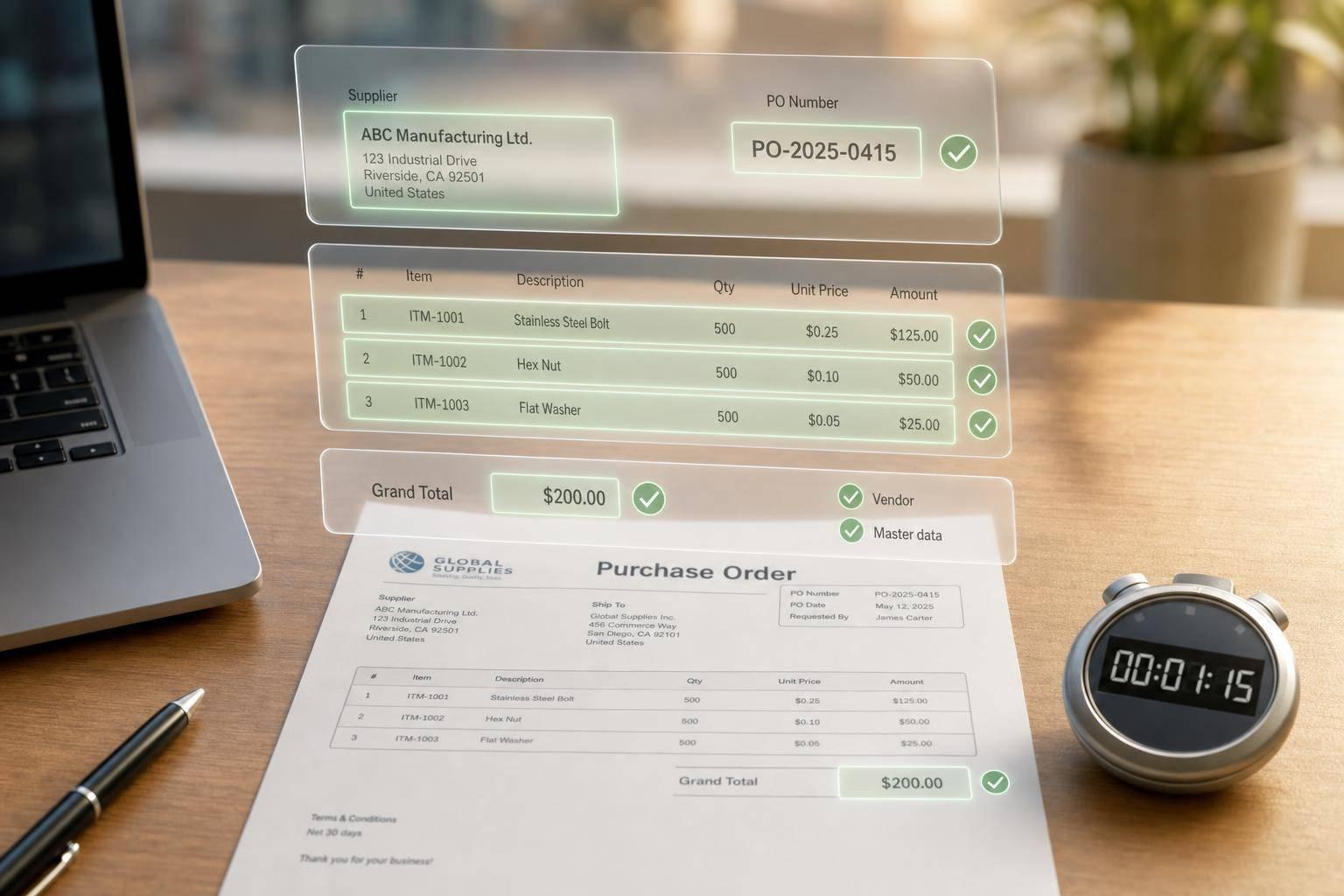 AI Automation • Jul 14, 2026 How AI Automates PO Data Extraction 11 min read](https://tryleverage.ai/blog/how-ai-automates-po-data-extraction)
##### [ ERP • Aug 14, 2026 PO Exception Triage: How to Rank What Actually Needs a Buyer 8 min read](https://tryleverage.ai/blog/pf/po-exception-triage-prioritize-purchase-order-alerts)
### See Leverage in Action
Stop chasing suppliers by email. Get real-time PO tracking and delivery visibility for your entire supply chain.
[Request a Demo](https://tryleverage.ai/request-a-demo)
#### Works with your ERP
Epicor, Infor, SAP, NetSuite, Microsoft Dynamics, and more. No EDI or supplier portal required.
[](https://tryleverage.ai)
Leverage AI delivers an end-to-end supply chain visibility platform powered by artificial intelligence that enables teams to ensure on-time delivery, in-full completion, within-budget costs, and high-quality standards.
Copyright © 2026 LVRG, Inc.
- Platform
- [CONNECT: Integrations](https://tryleverage.ai/integrations)
- [PARSE: Document Parsing](https://tryleverage.ai/document-parsing)
- [MEASURE: Supplier Performance](https://tryleverage.ai/supplier-performance)
- [PAY: Trade Finance](https://tryleverage.ai/payments)
- [ENGAGE: PO Automation](https://tryleverage.ai/purchase-order-automation)
- [TRACK: Shipments](https://tryleverage.ai/shipment-tracking)
- [COPILOT: AI Agents](https://tryleverage.ai/artificial-intelligence)
- Case Studies
- [Manufacturing](https://tryleverage.ai/case-study-manufacturing)
- [Distribution](https://tryleverage.ai/case-study-distribution)
- [Pharma & Biotechnology](https://tryleverage.ai/case-study-pharma-biotechnology)
- [Food Production](https://tryleverage.ai/case-study-food-production)
- [Furniture](https://tryleverage.ai/case-study-furniture)
- [Supplements](https://tryleverage.ai/case-study-supplements-manufacturing)
- [Packaging](https://tryleverage.ai/case-study-packaging-manufacturing)
- [Automative Parts Distributor](https://tryleverage.ai/case-study-auto-parts-distributor)
- [Commercial Equipment](https://tryleverage.ai/case-study-commercial-equipment)
- [Wood Processing Equipment](https://tryleverage.ai/case-study-wood-processing-equipment)
- Resources
- [Security & Trust](https://tryleverage.ai/security)
- [Terms of Service](https://tryleverage.ai/terms)
- [Privacy Policy](https://tryleverage.ai/privacy)
- [Vulnerability Disclosure Policy](https://tryleverage.ai/vdp)
- Company
- [Our Story](https://tryleverage.ai/our-story)
- [Podcast](https://tryleverage.ai/podcast)
- [Blog](https://tryleverage.ai/blog)
- [Careers](https://tryleverage.ai/careers)
- [Partners](https://tryleverage.ai/partners)
- [Contact Us](https://tryleverage.ai/contact)
-
-
-
```json
{
"@context" : "https://schema.org",
"@type" : "BlogPosting",
"author" : {
"@type" : "Person",
"name" : "Nadav Ullman",
"url" : "https://tryleverage.ai/blog/author/nadav-ullman"
},
"datePublished" : "2026-08-19T12:06:14.000Z",
"headline" : "Procurement Automation for Industrial Distributors: The 2026 Guide",
"image" : [ "https://tryleverage.ai/hubfs/blog-covers/cover-procurement-automation-industrial-distributors-guide.png" ],
"mainEntityOfPage" : {
"@id" : "https://tryleverage.ai/blog/pf/procurement-automation-industrial-distributors-guide",
"@type" : "WebPage"
},
"publisher" : {
"@type" : "Organization",
"logo" : {
"@type" : "ImageObject",
"url" : "https://tryleverage.ai/hubfs/Logo%20+%20Name%20Dark.png"
},
"name" : "Leverage AI"
}
}
```
```json
{
"@context" : "https://schema.org",
"@type" : "Organization",
"contactPoint" : {
"@type" : "ContactPoint",
"contactType" : "sales",
"telephone" : "+1-929-470-3086"
},
"description" : "AI-powered purchase order automation and supplier performance platform for manufacturers and distributors.",
"logo" : "https://tryleverage.ai/hubfs/leverage-logo-dark.png",
"name" : "Leverage AI",
"url" : "https://tryleverage.ai"
}
```